Author: Vijay Sajja
Why the Media & Telco Brands That Win Will Be the Ones That Can Predict and Act
It’s 2026. You have a billing issue with your streaming service. You know it’s straightforward. You know your provider made a mistake. And yet, here you are.
You navigate a phone menu designed in 2014. You’re put on hold. When you finally reach a person, that person asks you to explain everything from the beginning because their screen doesn’t show what you see. They’re sympathetic but constrained. Three transfers later, your “simple” issue consumes forty minutes of your afternoon.
This is not a niche complaint. According to McKinsey’s latest research on contact centers, 50 to 60 percent of all customer interactions remain transactional despite years of investment to eliminate them.1 At a major European bank, roughly half of all calls are still about recent transactions and bill payments. At a North American telco, 40 percent of call reasons are things like refund inquiries and plan questions. Simple stuff. The kind of stuff that should never require a phone call in the first place.
Meanwhile, 57 percent of customer care leaders expect call volumes to increase over the next two years.2 Not decrease. Increase.
So here we are: living through the most significant leap in artificial intelligence in human history, surrounded by language models that can write legal briefs and debug code, and yet the experience of resolving a billing error with your cable company has barely changed.
The gap between what AI can do and what most businesses actually do with it is the defining tension of our time.
That gap is what this piece is about. How we got here. Why the gap exists. And what it actually takes to close it.
How We Got Here
I first started working in media and entertainment more than 20 years ago. The landscape was unrecognizable then. Blockbuster was a household name. Living room cabinets were full of CDs. Your entertainment schedule was dictated by your linear TV package.
Today, we live in a world of digital, hyper-personalized entertainment. Brands like Netflix, Spotify, and DAZN have displaced behemoths and put more content in your pockets and TV screens than what you can consume in multiple lifetimes. I’ve watched this seismic shift from every vantage point: as a young professional seeing subscription businesses try to adapt, and now as a CEO helping those businesses navigate new waves of transformation.
There’s never been a better time to weigh in on what I’ve learned about the winners and losers of each economic shift. Because in my view, we’re standing at the edge of the biggest one yet.
The progression has been remarkably consistent. In the Distribution Economy (through the 1990s), the winners were the companies that could reach people. Build the pipes. Get signal into homes. Then came the Digitization Economy, where the question shifted to: can you digitize? Netflix, Spotify, and the early streaming pioneers seized the opportunity the internet handed them: unprecedented, frictionless access to users.
The losers of this time were just as telling. In the U.S., Blockbuster, Tower Records, and the traditional linear broadcasters who dismissed streaming as a fad had enormous scale, trusted brands, and deep content libraries. What they lacked was the conviction to cannibalize their own model before someone else did.
By the time they recognized the shift, the window had nearly closed.
But digitization alone proved to be a temporary moat. The Content Economy rewarded whoever owned the hits. Then the Experience Economy raised the bar again: it wasn’t enough to have content in an app. Signing up had to be seamless. Discovery was expected to feel effortless.
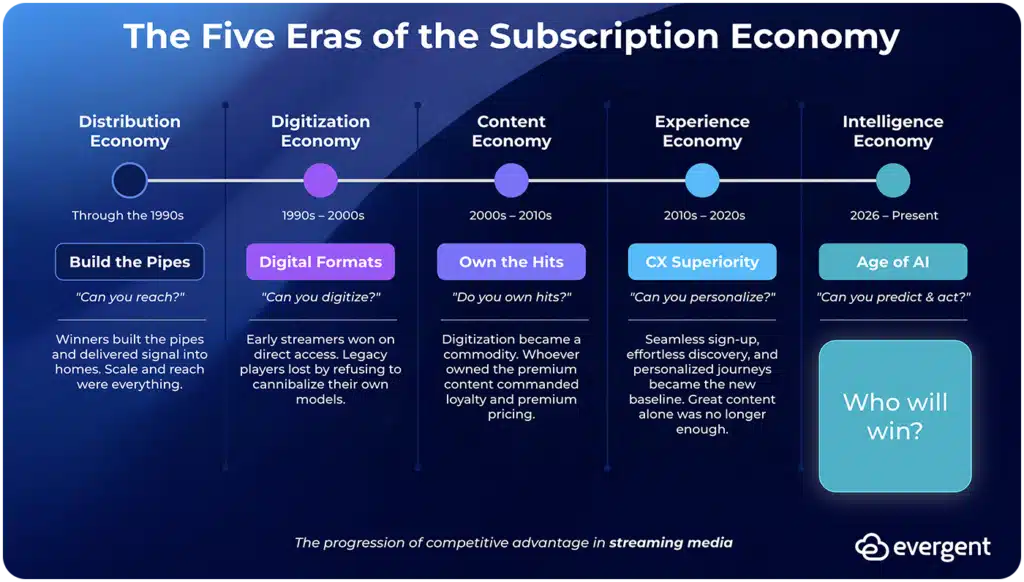
I watched brands with exceptional content catalogues bleed subscribers. Not because of what they offered, but because of how it was packaged: too many steps at checkout, repetitive recommendation engines, and support that required a level of patience most subscribers weren’t willing to give.
The brands that won weren’t just digital. They were digitally excellent. Consider the way Spotify turned music discovery into a brand identity, with features such as ‘Discover Weekly’ making listeners feel understood rather than served.
Great content paired with a great experience. That combination proved decisive.
Now in 2026, seamless and increasingly personalized digital experiences are the baseline for survival.
The expectations, however, are shifting again.
The Intelligence Economy
When any of our team members speak with peers across the industry, we’ve begun to define the next era by a single question: Can you predict and act?
Not AI as a feature. Not a recommendation widget or a smarter search bar. Intelligence as core infrastructure.
In much the same way that electricity didn’t just improve the candle but made it obsolete, and the internet went beyond accelerating mail to essentially replace it, AI is shifting from a tool people use for answers to the foundational layer capable of autonomously powering entire business operations.
This is the Intelligence Economy.
Success no longer belongs to the brands offering the best interface for a customer to interact with. It belongs to the brands whose entire operation, from acquisition, retention, and care to pricing and content delivery, can be orchestrated by systems intelligent enough to act on a subscriber’s behalf before that subscriber even knows they need something.
This shift is not from dumb to smart. It’s from reactive to autonomous. From tools that inform decisions to systems that make them.
What does that actually look like? Consider a few scenarios, much closer to reality than most people realize.
A free trial user on a gaming subscription platform has been spending 80% of their session time in two specific game genres. Three days before the trial expires, the user receives a personalized upgrade offer featuring those exact genres, priced at a point the platform’s model has determined is within that user’s willingness to pay. The experience doesn’t feel like marketing. It feels like understanding.
A pay TV subscriber gradually reduces weekly viewing over six weeks’ time. Before logging in to cancel, a relevant add-on offer or plan restructure is delivered proactively. The intervention arrives before intent becomes action.
A telco customer calling about a billing dispute is met not by an agent reading from a script, but by an AI system that has already reviewed account history, identified the likely source of confusion, and surfaced three resolution options, ranked by satisfaction outcomes for similar customers in comparable situations. The call is resolved in under two minutes. The customer leaves more loyal than when they called.
These are not AI-assisted experiences. They’re AI-executed ones. That distinction matters enormously.
In each scenario, intelligence evolves beyond prediction into action: identifying the problem, determining the response, and executing it. This is what agentic AI means in practice. Not a single chatbot answering questions, but multiple specialized agents, coordinating autonomously across retention, pricing, support, and personalization, orchestrated by a central intelligence layer that learns from every interaction.
The Stakes
The urgency is not theoretical. Industry studies show that 30 to 35 percent of new digital subscribers abandon a service within six months, typically because personalization falls short, engagement is low, or pricing feels off. Since acquiring a subscriber costs five to seven times more than keeping one, every avoidable churn compounds the cost.3
The analyst community is equally decisive. By 2028, according to Gartner, 60% of brands will use agentic AI to deliver one-on-one interactions through persistent AI agents spanning marketing, sales, and support simultaneously.4 A year beyond that, by 2029, such agents are predicted to autonomously resolve 80% of common customer service issues. These will be solutions that don’t just provide information, but take real action: modifying accounts, navigating systems, and resolving disputes.5
Commercially, companies will spend more than $30 billion on AI infrastructure to compete on personalized experiences by 2027, according to IDC. This year, the analyst firm estimates 45% of individuals will search for information and engage with brands directly through GenAI interfaces. Intelligent, conversational AI is already becoming the primary customer touchpoint.6
And the McKinsey data on contact centers reinforces the paradox: even as AI capabilities accelerate, human-to-human contact center interactions have grown 2 percent annually since 2010.7 Not because customers prefer inefficiency, but because digital experiences remain too broken to trust with anything that matters. The technology exists to fix this. The implementation largely does not.
For telecoms and pay TV operators, where revenue growth has stalled below 2% annually, intelligence is no longer a strategic option. It is the primary lever for ARPU growth and churn reduction.8
Investing with Discipline
In closing, allow me to offer a hedge, a hedge I wish was more front and center for many in our industry.
Every day I encounter new products claiming agentic capabilities and predictive intelligence. Some are impressive. Many are rebranded versions of tools we’ve had for years wrapped in new terminology. Gartner pointedly has termed this ‘agent washing.’ The firm’s research suggests that of the thousands of vendors claiming agentic AI, only around 130 are operating with genuinely agentic systems.9
In this Intelligence Economy we find ourselves in, the risk is not that the technology fails to materialize. The real risk is that organizations, under pressure to appear innovative, deploy AI untethered from real problems or measurable outcomes.
Intelligence deployed without discipline isn’t infrastructure. It’s noise.
The research firm Forrester has attached a number to this potential downside: one in three brands will actively erode customer trust through premature or poorly designed AI self-service deployments.10
In subscription businesses, where trust is the foundation of every recurring revenue relationship, that’s too big a risk to take lightly. A bad AI experience doesn’t just fail to retain a customer. It accelerates their exit and poisons their perception of the brand on the way out.
The brands that win will not be the ones moving fastest toward AI adoption in the abstract. They’ll be the ones shifting toward specific, measurable subscriber solutions: from churn prediction and personalized discovery to frictionless care and dynamic value delivery. These innovators will build the data governance and infrastructure to do it sustainably.
Our own clients have reinforced this in conversation after conversation: AI is not the right tool for every problem. Be strategic about what actually needs automation. That earned wisdom matters more than any vendor pitch.
Intelligence must be treated like any critical infrastructure: designed with care, maintained with rigor, and held accountable to outcomes.
The technology is increasingly accessible. The discipline to deploy it as true infrastructure, not as a feature, not as a headline, is the actual differentiator.
Where We Go from Here
At Evergent, this is what we build for.
Our platform processes over a billion subscriber journeys across more than 180 countries. That data isn’t just a metric on a slide. It’s the foundation of an AI flywheel: every interaction makes the system smarter, every insight creates a more personalized experience, and every outcome feeds back into the model.
We’re investing in autonomous AI agents designed specifically to predict, act, and learn across the subscriber lifecycle: retention agents that intervene before a subscriber decides to leave. Pricing agents that optimize what each customer pays based on what they value. Support agents that resolve issues in seconds. All coordinated by an orchestration layer that ensures they work together, not in silos.
We’ve already seen churn prediction accuracy above 94% in production pilots with some of the world’s largest streaming and gaming platforms. These aren’t hypotheticals. They’re outcomes.
The future of subscription businesses is a fundamentally different relationship between brand and subscriber.
A relationship in which the brand knows what the subscriber wants before they ask, removes obstacles before they notice, and earns loyalty not through lock-in but through genuine, continuously improving relevance.
That is the Intelligence Economy.
This shift is closer than many of us realize. And the time to start building for it is now.The shift to the Intelligence Economy won’t wait. Neither should you.
Sources
1 McKinsey & Company, March 2025. “The contact center crossroads: Finding the right mix of humans and AI.” https://www.mckinsey.com/capabilities/operations/our-insights/the-contact-center-crossroads-finding-the-right-mix-of-humans-and-ai
2 McKinsey & Company. (2024). Where is customer care in 2024? McKinsey & Company. https://www.mckinsey.com/capabilities/operations/our-insights/where-is-customer-care-in-2024
3 Scientific Reports, 2025. “Advanced customer churn prediction for a music streaming digital marketing service.” https://www.nature.com/articles/s41598-025-28357-z
4 Gartner, January 2026. “Gartner Predicts 60% of Brands Will Use Agentic AI to Deliver Streamlined One-to-One Interactions by 2028.” https://www.gartner.com/en/newsroom/press-releases/2026-01-15-gartner-predicts-60-percent-of-brands-will-use-agentic-ai-to-deliver-streamlined-one-to-one-interactions-by-2028
5 Gartner, March 2025. “Gartner Predicts Agentic AI Will Autonomously Resolve 80% of Common Customer Service Issues Without Human Intervention by 2029.” https://www.gartner.com/en/newsroom/press-releases/2025-03-05-gartner-predicts-agentic-ai-will-autonomously-resolve-80-percent-of-common-customer-service-issues-without-human-intervention-by-20290
6 IDC FutureScape, January 2025. “IDC Predicts: AI Spending to Exceed $30 Billion by 2027 for Personalized Customer Experiences.” https://my.idc.com/getdoc.jsp?containerId=prAP53135925
7 McKinsey & Company, March 2025. As cited above.
8 IDC Worldwide Semiannual Telecom Services Tracker, November 2025. “With Telecom Services Spending Growing Less than 2% Annually, Operators Turn to AI to Boost EBITDA Margins.” https://my.idc.com/getdoc.jsp?containerId=prUS53913925
9 Gartner, June 2025. “Gartner Predicts Over 40% of Agentic AI Projects Will Be Canceled by End of 2027.” https://www.gartner.com/en/newsroom/press-releases/2025-06-25-gartner-predicts-over-40-percent-of-agentic-ai-projects-will-be-canceled-by-end-of-2027
10 Forrester Research, October 2025. “Forrester’s 2026 B2C Marketing, CX, & Digital Business Predictions: One-Third Of Brands Will Erode Customer Trust Through Self-Service AI.” https://www.businesswire.com/news/home/20251028326446/en/

Establishing Evergent in 2008, Vijay leads the company’s vision to help subscription businesses drive growth through modern monetization and customer lifecycle innovation.
Vijay Sajja
Founder & CEO