Rethinking Churn: What Subscriber Behavior Taught Us About Churn Prediction: Whitepaper
If content were the retention lever everyone assumes it is, record spending would have slowed churn. It didn’t. Monthly streaming churn climbed from 2% in 2019 to about 5.5% by early 2025.
A whitepaper from Evergent on what an AI analysis of real Pay-TV transaction data reveals about why subscribers actually leave, and what separates a churn score from a subscriber you keep.
What You’ll Get
What’s Inside the Whitepaper
Three findings from an AI analysis of real Pay-TV transaction data, each one challenging an assumption the industry has spent billions defending.
1. Churn is multi-causal and payment-led
Most churn predictors are payment-related, and none are viewership metrics. See how payment behaviour, equipment footprint, tenure, time on the basic tier, and collections history converge into risk, well before a cancellation.
2. The threat you are not measuring is dormancy
Voluntary churners watch less, but absent viewing doesn’t predict cancellation; it predicts dormancy: subscribers who still pay but have stopped watching. The whitepaper maps the Engaged-to-Dormant transition across seven viewership signals and a four-state framework.
3. Prediction does not equal retention
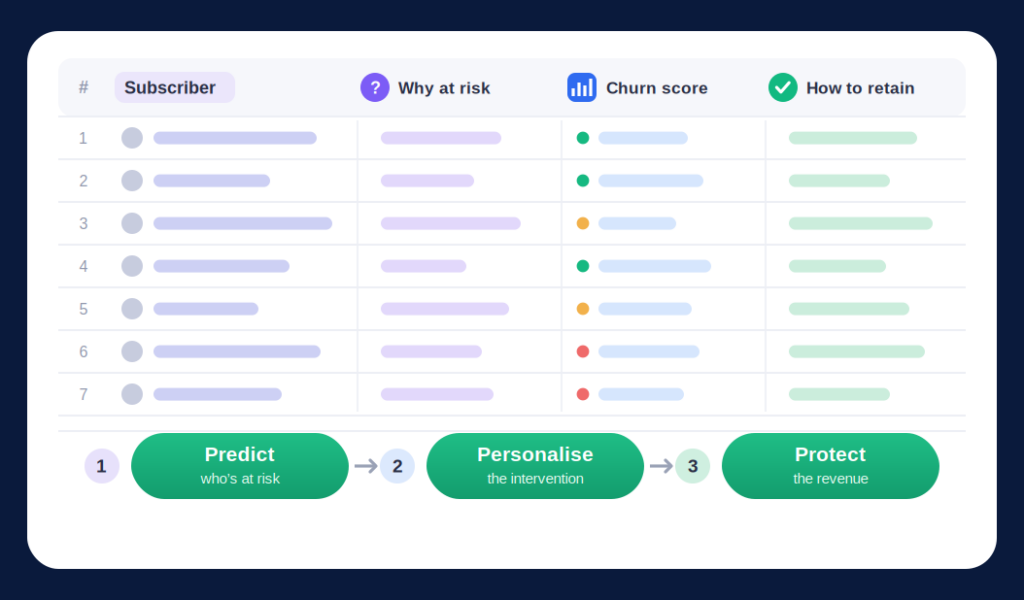
The whitepaper shows why the management layer, which intervention reaches which subscriber, on which channel, at which moment, is what actually saves subscribers, across prevention, deflection, and winback.
HOW IT WORKS
How to Use the Whitepaper
Benchmark
Hold your own retention assumptions against the findings. If your dashboards still read only Active or Churned, start there.
Diagnose
Look for dormancy hiding in your active base using the seven viewership signals and the four-state framework.
Act
Move the conversation from prediction accuracy to churn management, matching interventions to risk across prevention, deflection, and winback.
Stop reacting. Start predicting.
Download the free whitepaper and see what an AI analysis of real Pay-TV data reveals about why subscribers leave, and what it takes to keep them.