As AI infrastructure grows, so does the complexity of charging for it. Unlike traditional subscription businesses, AI infrastructure providers don’t sell a fixed monthly plan – they charge customers based on how much compute they actually use. That could mean GPU hours, inference requests, tokens processed, storage consumed, or a combination of all of these.
This pricing approach, known as usage-based billing, has become the standard for GPU cloud providers and neoclouds because it aligns costs with customer usage. It gives customers the flexibility to scale their AI workloads while allowing providers to monetize expensive GPU infrastructure more efficiently.
However, implementing usage-based billing for AI infrastructure is far more complex than simply measuring usage. Providers need to accurately meter consumption, apply different pricing models, generate invoices, manage enterprise contracts, and often share revenue across multiple partners – all while ensuring customers have real-time visibility into their spending.
This guide explains how usage-based billing works for AI infrastructure, the pricing models used by GPU cloud providers, the challenges of billing for AI services, and the capabilities operators should look for in a modern monetization platform.
What Is Usage-Based Billing?
Usage-based billing is a pricing model where customers pay based on how much of a service they actually use, rather than a fixed monthly or annual fee. For AI infrastructure providers, that usage could include GPU hours, API requests, inference tokens, storage, or network bandwidth. The more resources a customer consumes, the more they pay.
This approach is a natural fit for AI infrastructure because usage can vary significantly from one customer to another. A startup experimenting with a small AI model may use only a few GPU hours, while an enterprise training large language models could consume thousands.
It’s also important to distinguish between pricing and billing.
- Pricing defines what customers should pay – for example, hourly rates, prepaid credits, or volume discounts.
- Billing is the process of measuring usage, calculating charges, generating invoices, and collecting payment.
A successful usage-based business needs both: a pricing strategy that customers understand and a billing platform that can apply those pricing rules accurately at scale.
How to Implement Usage-Based Billing for AI Infrastructure: A Step-by-Step Process
Implementing usage-based billing isn’t something that happens overnight. As AI infrastructure businesses grow, they typically move from a simple billing model to one that can support multiple pricing plans, enterprise customers, and real-time usage tracking.
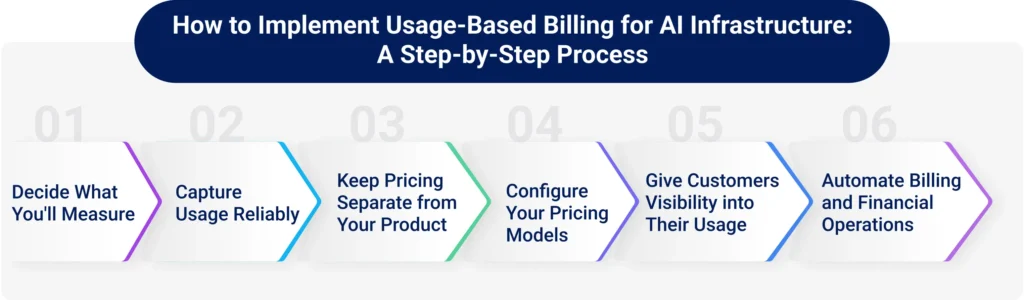
While every provider has different requirements, most successful implementations follow the same six steps.
Step 1: Decide What You’ll Measure
Before you can bill customers, you need to decide what they’re being charged for.
Depending on your business model, this could include GPU hours, GPU seconds, inference tokens, API requests, storage, or network usage. These are known as usage events – the individual activities that customers will eventually be billed for.
It’s important to define these events clearly from the start. Every usage event should include details such as when it occurred, which customer generated it, and which resource was used. A consistent structure makes billing more accurate and much easier to manage as your business grows.
Step 2: Capture Usage Reliably
Once you’ve defined your usage events, the next step is making sure they’re captured accurately.
Every GPU hour, API request, or token processed should be recorded and sent to your billing platform without being missed or duplicated. Even small errors in usage tracking can lead to incorrect invoices, customer disputes, or lost revenue. For AI infrastructure providers handling thousands of events every second, reliable metering is one of the most important parts of the billing process.
Step 3: Keep Pricing Separate from Your Product
As your pricing evolves, you don’t want developers rewriting application code every time the business introduces a new pricing plan.
Instead, your product should simply record customer usage, while a pricing engine applies the appropriate billing rules. This allows business teams to launch new pricing plans, offer promotions, or introduce discounts without waiting for engineering releases. Separating pricing from product logic also makes it much easier to experiment with new commercial models as your business grows.
Step 4: Configure Your Pricing Models
With accurate usage data flowing into your billing platform, you can now decide how customers will be charged.
This may include hourly pricing, prepaid credits, committed-use discounts, tiered pricing, spot instances, or token-based billing. Different customers may use different pricing models, so your billing platform should make it easy to assign, update, and manage pricing plans as customer needs change.
Step 5: Give Customers Visibility into Their Usage
Usage-based billing works best when customers always know how much they’re consuming.
Real-time dashboards, spending alerts, budget limits, and automatic top-ups help customers track their costs before they receive an invoice. These features reduce unexpected charges, improve trust, and give customers greater confidence in using your platform.
Step 6: Automate Billing and Financial Operations
The final step is turning usage into revenue. Once usage has been measured and priced, the billing platform should automatically generate invoices, process payments, retry failed transactions, and produce the financial records needed by the business.
For enterprise customers, this also includes maintaining accurate, auditable billing records that support accounting and compliance requirements. Automating these processes helps providers scale without increasing manual finance and operations work.
Why Standard Billing Platforms Fall Short for AI Infrastructure
Many AI infrastructure providers begin by evaluating legacy billing platforms. These platforms are excellent for subscription-based businesses like SaaS, where customers typically pay a fixed monthly or annual fee.
However, AI infrastructure is very different from traditional software subscriptions. Instead of billing for users or licenses, providers need to bill for constantly changing usage – such as GPU hours, inference requests, tokens, storage, and network consumption. As pricing models become more complex, many organizations discover that conventional billing platforms weren’t designed for these requirements. Here are some of the biggest challenges.
Limited Support for Complex Usage Metering
Traditional billing platforms usually expect usage to be summarized before it’s sent for billing – for example, the total number of API calls made during a month.
AI infrastructure generates much more detailed data. Providers may need to capture thousands of GPU usage events every second, measure fractional GPU usage, and combine multiple resources into a single bill. Handling this level of real-time, high-volume metering requires capabilities that many standard billing platforms don’t provide out of the box.
Difficulty Supporting Modern AI Pricing Models
AI infrastructure providers rarely rely on a single pricing model. A customer might have reserved GPU capacity, pay per token for inference, use prepaid credits for development, and receive enterprise discounts – all at the same time.
While traditional billing platforms can often support these scenarios through custom development, introducing or changing pricing models can become slow, expensive, and engineering-intensive.
No Built-In Support for Multi-Party Revenue Sharing
Modern AI ecosystems often involve multiple participants. For example, a customer may purchase an AI service that combines GPU infrastructure from one provider, an AI model from another company, and software delivered through a marketplace or reseller.
The billing platform needs to calculate how much revenue each participant should receive and generate accurate settlement reports. Most subscription billing platforms weren’t designed to handle these types of multi-party financial workflows.
Limited Enterprise Billing Capabilities
Individual developers may only need a credit card and an invoice. Large enterprises have much more complex procurement and finance requirements. They often expect consolidated billing across multiple teams, purchase order support, spending controls, account hierarchies, and tax-compliant invoicing across different countries and regions.
These capabilities are essential for serving enterprise customers but are often limited in billing platforms designed primarily for SaaS businesses.
Limited Visibility into Profitability
For AI infrastructure providers, generating an invoice is only part of the story. The cost of delivering AI services can change depending on GPU prices, infrastructure utilization, or the AI models being used.
To understand whether a customer or pricing plan is actually profitable, providers need visibility into both revenue and cost. Without real-time insights into margins, it becomes difficult to optimize pricing, control costs, and make informed business decisions as the platform grows.
Build vs. Buy: Should You Build Your Own AI Billing System?
As AI infrastructure businesses grow, most eventually face the same question: Should we build our own billing platform or use an existing solution? The answer depends on your pricing complexity, engineering resources, and long-term business goals. Each approach has advantages, but each also comes with trade-offs.
Building In-House
Building your own billing platform gives you complete control over features and architecture. It also avoids relying on a third-party vendor.
The challenge is that billing systems become far more complex than they first appear. Beyond tracking usage, you’ll need to support pricing rules, invoice generation, payment processing, failed payment recovery, tax calculations, enterprise contracts, and financial reporting. As your pricing evolves, maintaining all of this can consume engineering time that could otherwise be spent improving your core AI platform.
For companies with highly specialized requirements and large engineering teams, building in-house may make sense. For many others, the long-term maintenance effort becomes difficult to justify.
Traditional SaaS Billing Platforms
Leading platforms can support simple AI infrastructure pricing, such as charging by GPU hour. However, as providers introduce prepaid credits, committed-use contracts, token-based billing, or partner revenue sharing, these platforms often require significant customization to support more advanced pricing models.
Open-Source Billing Platforms
Open-source projects provide a flexible middle ground. They offer a foundation for usage-based billing while allowing organizations to host and customize the platform themselves. The trade-off is that your team is still responsible for operating, scaling, and extending the platform, particularly if you need enterprise billing, partner settlements, or advanced financial workflows.
Purpose-Built AI Infrastructure Billing Platforms
A newer generation of billing platforms has been designed specifically for usage-intensive businesses such as AI infrastructure providers. These platforms combine high-volume usage metering, flexible pricing, enterprise billing, and multi-party revenue sharing into a single commercial platform. While the vendor ecosystem is smaller than the traditional SaaS billing market, these solutions are often a better fit for organizations operating GPU clouds, AI marketplaces, or managed inference services.
How Evergent Helps GPU Cloud Operators Get Billing Right
Throughout this guide, we’ve explored why billing AI infrastructure is fundamentally different from billing traditional software. Providers need to meter high-volume usage, support multiple pricing models, manage enterprise customers, and often distribute revenue across complex partner ecosystems.
Evergent was built to solve these commercial challenges.
Drawing on more than a decade of experience building monetization platforms for industries such as telecommunications, media, and streaming – where usage-based billing and multi-party settlements are business-critical- Evergent brings that expertise to AI infrastructure providers.
Key capabilities include:
- Flexible usage-based pricing: Support for GPU-hour billing, token-based pricing, committed-use contracts, prepaid credits, tiered pricing, spot instances, fractional GPUs, and hybrid pricing models – all configurable without changing application code.
- High-volume usage metering and rating: Capture GPU usage, inference requests, storage consumption, and other usage events, then automatically apply the correct pricing rules to generate accurate billing records.
- Multi-party revenue management: Calculate revenue splits, manage partner rate cards, and automate settlement workflows for AI marketplaces, model providers, and reseller ecosystems.
- Enterprise-ready billing: Support consolidated invoicing, account hierarchies, purchase orders, spending controls, and tax compliance for organizations operating across multiple business units and regions.
- Self-service customer experiences: Enable customers to monitor usage, manage credits, set spending limits, and download invoices without relying on support teams.
- Real-time commercial insights: Track revenue, margins, utilization, credit consumption, and settlement activity to help operators understand both business performance and profitability.
Whether you’re launching a new GPU cloud, expanding into managed AI services, or building a multi-partner AI marketplace, Evergent provides the commercial infrastructure needed to turn AI usage into predictable, scalable revenue.

Frequently Asked Questions About Usage-Based Billing for AI
What is usage-based billing for AI companies?
Usage-based billing is a pricing model where AI companies charge customers based on the resources they consume, such as GPU hours, inference tokens, API calls, storage, or compute time, instead of a fixed monthly subscription. This approach aligns pricing with actual usage, making it a better fit for AI services where infrastructure costs can vary significantly between customers.
What’s the difference between usage-based billing and consumption-based billing?
There is no difference. Usage-based billing, consumption-based billing, metered billing, and pay-as-you-go pricing all describe charging customers based on what they use rather than a fixed recurring fee. While the terminology varies across vendors, the underlying billing model is the same.
How do you implement usage-based billing for AI infrastructure?
To implement usage-based billing, you need to measure customer usage, capture it accurately, apply pricing rules, generate invoices, and process payments. Most AI infrastructure providers follow six key steps: define usage events, build a reliable metering pipeline, separate pricing from application code, configure pricing models, provide real-time usage visibility, and automate billing and financial operations.
What is the best billing model for a GPU cloud?
There isn’t a single best billing model for a GPU cloud. Most providers combine multiple pricing models to serve different customer needs. For example, an operator may use committed-use contracts for enterprise customers, per-token pricing for managed inference, prepaid credits for developers, and spot pricing for interruptible workloads.
How do you prevent bill shock in usage-based AI billing?
The best way to prevent bill shock is to give customers real-time visibility into their usage and spending. Usage dashboards, budget alerts, spending limits, automatic top-ups, and usage thresholds help customers manage costs before they receive an invoice, reducing disputes and improving trust.
Should AI companies build or buy their billing system?
Most AI companies benefit from buying a billing platform rather than building one from scratch.
While an in-house solution offers maximum flexibility, it also requires significant engineering effort to support usage metering, pricing, invoicing, payments, tax, compliance, and ongoing maintenance. Purpose-built billing platforms allow engineering teams to focus on building AI products instead.
Does usage-based billing affect revenue recognition?
Yes. Usage-based billing can affect how AI companies recognize revenue, particularly for enterprise contracts with variable usage. To support accounting standards such as ASC 606, providers need accurate, timestamped, and auditable usage records that can be used for financial reporting and resolving billing disputes.