If you work with pricing for cloud, SaaS, telecom, or digital services, you have probably come across the terms consumption-based billing and usage-based billing. People often use them interchangeably because they describe a similar idea: customers pay based on how much they actually use.
Consumption-based billing means customers pay for what they consume rather than a fixed subscription or a preset number of seats. The more they use, the more they pay. The less they use, the less they pay. This is also the basic principle behind usage-based billing, pay-as-you-go pricing, and metered billing.
The difference between these terms is usually about perspective:
| Term | Typical Framing |
| Consumption-based billing | The buyer or finance team’s view of what was consumed and what the customer owes |
| Usage-based billing | The provider or product team’s view of measuring usage and applying pricing |
| Pay-as-you-go | A pricing approach that emphasizes flexibility and limited upfront commitment |
| Metered billing | The technical process of measuring and recording usage |
In practice, these models can apply to measurable activities such as API calls, compute hours, gigabytes of data, transactions, messages, or minutes used.
This guide explains how consumption-based billing works, how it compares with usage-based billing and other pricing models, where it creates value, what challenges it introduces, and how businesses can implement it successfully.
What Is Consumption-Based Billing?
Consumption-based billing is a pricing model in which customers pay according to the amount of a product or service they actually consume over a defined period. Instead of charging a fixed monthly fee, the provider measures consumption and calculates the bill based on that activity.
A simple example is an electricity bill. You don’t pay the same amount every month, regardless of how much electricity you use. Your utility provider measures your consumption in kilowatt-hours and charges you accordingly. Consumption-based billing applies the same principle to digital services such as cloud infrastructure, API usage, data processing, and AI services.
What Defines a Consumption-Based Billing Model?
For a pricing model to be considered consumption-based, it typically has three core elements:
- A measurable unit of consumption: This could be compute hours, gigabytes stored, messages sent, API calls, or transactions processed.
- Metering infrastructure: Systems that accurately capture and track consumption in real time or near real time.
- Variable invoicing: The final invoice changes according to actual consumption rather than remaining fixed.
| Fixed Billing | Consumption-Based Billing |
| $500/month regardless of usage | $0.10 per unit × actual units consumed |
| Predictable cost, but customers may pay for unused capacity | Costs align more closely with actual consumption, but can vary month to month |
| Customers pay even when usage is low | Customers pay less when they consume less |
Consumption-based billing can help customers avoid paying for resources they do not use. For providers, it can lower the barrier to adoption because customers can start with a smaller financial commitment and increase spending as they derive more value.
Consumption-based billing does not necessarily mean there is no commitment. Providers may offer committed-use discounts or prepaid credits that give customers better rates in exchange for a minimum spending commitment. The underlying billing model remains consumption-based, while the commitment structure adds greater predictability for both sides.
Consumption-Based Billing vs. Usage-Based Billing: Is There Actually a Difference?
In short: not really. Consumption-based billing and usage-based billing essentially describe the same idea: customers are charged based on how much they actually use. You will often see the terms used interchangeably in contracts, vendor websites, and analyst reports.
The difference usually comes down to perspective.
- Usage-based billing usually reflects the provider’s perspective. It focuses on how usage is measured, such as API calls, compute hours, or gigabytes transferred, and how that usage is billed.
- Consumption-based billing reflects the buyer’s perspective. It focuses on what the customer consumed and how much they pay for it.
When the Distinction Actually Matters
For most businesses, the distinction is not significant. However, the terms can carry more specific meaning in certain situations:
| Scenario | What to Watch For |
| Enterprise procurement | “Consumption” may refer to committed-use agreements or prepaid credits. The buyer commits to spending while paying based on actual consumption. |
| Revenue recognition | Finance teams may distinguish usage-based fees from consumption against a prepaid balance because revenue recognition timing can differ. |
If you are evaluating a consumption billing model for your product or comparing vendors, focus less on the terminology and more on the mechanics:
- What is being measured?
- How are rates calculated?
- Are there tiers, discounts, or minimum commitments?
- How is usage reflected on the invoice?
- How are prepaid credits or committed-use agreements handled?
Related terms such as pay-as-you-go, metered billing, and pay-per-use also describe variations of the same underlying concept.
How Consumption-Based Billing Works: From Metering to Invoice
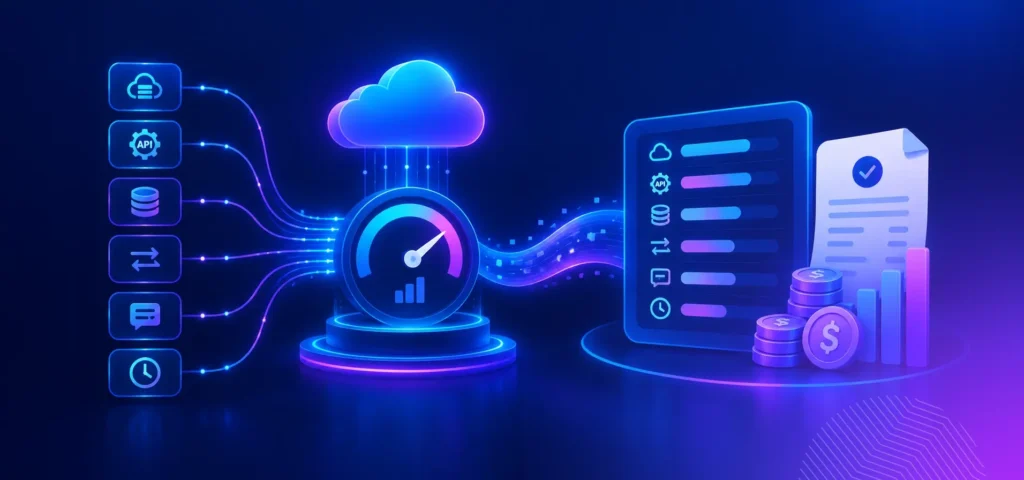
Consumption-based billing works in three core steps: metering, rating, and invoicing.
Each step plays a different role. Metering captures usage, rating applies the appropriate pricing rules, and invoicing turns those rated charges into a customer bill. If any step is inaccurate, it can lead to incorrect charges, revenue leakage, or disputes.
| Step | What Happens | Example: Cloud Compute |
| 1. Metering | Raw usage data is captured in real time or near real time. | A server tracks every vCPU-hour a customer uses. |
| 2. Rating | Usage is matched to the customer’s pricing rules, such as tiered, volume-based, or per-unit pricing. | The first 1,000 vCPU-hours are charged at $0.05; usage above that is charged at $0.03. |
| 3. Invoicing | Rated charges are compiled into an invoice for the billing period. | The monthly invoice reflects 1,400 vCPU-hours and a total charge of $62. |
Benefits of Consumption-Based Billing for Buyers and Providers
Consumption-based billing truly shines by matching costs with the value both buyers and providers gain from their transactions. Let’s break down the advantages for each side.
For Buyers
- Pay for what you actually use
Say goodbye to excess software licenses that you don’t utilize! For instance, a fintech company running machine learning tasks on Azure pays only for the compute hours they need. During quiet months, they aren’t paying for unused resources, and when they need more, they can easily scale up without renegotiating contracts.
- Easier entry point
New customers can start off small without feeling pressured to sign a big annual contract. This makes it simpler to secure budget approval and experiment with a product before making a larger commitment.
- Clear invoicing
With consumption billing, each charge is tied to a measurable unit, such as API calls or GB stored, allowing finance teams to trace costs back to specific business activities. This clarity helps allocate expenses accurately across departments.
For Providers
- Revenue grows with customer success
When customers find value in what they’re using, they consume more, which naturally boosts revenue without a separate upsell effort. This model is why cloud providers like AWS and GCP have adopted consumption-based pricing as their standard.
- Lower churn rates
Customers aren’t locked into flat fees they might outgrow or not fully use, so they have less motivation to leave. The flexible pricing adjusts to their needs over time.
- Valuable product insights
Data from metered usage gives you a clear picture of which features are loved and which aren’t, giving your product and customer success teams actionable insights.
Challenges of Consumption Billing and How to Solve Them
While consumption-based billing is a great way to connect costs with the value customers receive, it also brings real operational hurdles for both businesses and their clients. Let’s look at the main challenges and straightforward ways to tackle them.
1. Revenue unpredictability
Because customers pay only for what they use, predicting quarterly revenue can be tricky. For example, a cloud provider might notice that a customer’s spending fluctuates by as much as 40% from one month to the next because of seasonal demand.
Solution: Consider offering committed-use discounts or prepaid credits. This approach helps establish a revenue baseline without completely moving away from the consumption billing model.
2. Bill shock
Customers sometimes spin up resources and lose track of how much they’re using, leading to surprise invoices that can erode trust and drive them away.
Solution: Implement real-time usage dashboards, set up configurable spending alerts, and establish budget limits. With access to current usage figures, customers can avoid those unpleasant surprises.
3. Billing complexity
Measuring consumption metrics like compute hours, storage, API calls, and data transfer, and applying tiered or volume-based rates, can make invoices hard to generate and understand.
Solution: Invest in a robust rating engine that can handle multi-dimensional metering and ensure that invoices provide clear, itemized charges. This way, customers can understand their bills without contacting support.
4. Revenue recognition compliance
With variable billing, adhering to ASC 606 regulations can become complicated, since revenue is recognized as service consumption occurs, rather than when the contract is signed.
Solution: Automate revenue recognition workflows linked directly to metering data to ensure that recognized revenue aligns with actual service delivery.
Industries Where Consumption-Based Billing Thrives
Consumption-based billing works best in industries where customer usage fluctuates and is hard to predict upfront. If a product or service has a clear, measurable usage metric, consumption-based pricing can be a strong alternative to flat-rate pricing.
Here are some of the key industries that use this model:
| Industry | What’s Metered | Example |
| Cloud / IaaS | Compute hours, storage, data transfer | AWS, Azure, and GCP charge based on the resources customers actually use. |
| SaaS (AI & API products) | API calls, tokens, transactions | OpenAI charges per token, while Twilio bills based on messages or minutes used. |
| Telecom | Data (GB), call minutes, SMS | Postpaid mobile plans often include usage-based charges or overage fees. |
| Utilities | Electricity (kWh), water, gas | Utility providers bill customers based on actual consumption. |
| Financial Services / Payments | Transaction volume or value | Stripe, for example, charges based on payments processed. |
How to Implement Consumption-Based Billing Successfully
Moving to a consumption-based billing model is more than a pricing change. It affects metering, billing, finance, and how customers understand and manage their usage.
A successful implementation starts with the right billing infrastructure and clear processes.
1. Define What You’re Metering
Choose a unit of consumption that customers can understand and influence. Common examples include API calls, gigabytes of storage, compute hours, and messages sent.
The metric should clearly connect to the value customers receive. If customers cannot understand why they are being charged for a particular unit, billing disputes are likely to follow.
For example, an AI platform might charge per thousand API requests, while a cloud infrastructure provider might bill based on vCPU hours. Both metrics are measurable, easy to track, and connected to customer usage.
2. Build or Buy the Right Infrastructure
A consumption-based billing model requires four core capabilities:
| Capability | What It Does |
| Metering | Tracks detailed usage events in real time or near-real time |
| Rating engine | Applies pricing rules such as tiers, volume discounts, or offsets to usage data |
| Invoice generation | Creates clear, itemized invoices based on rated usage |
| Dunning and alerts | Notifies customers about spending thresholds and manages payment failures |
Adapting a traditional subscription billing system to complex consumption models can create problems as usage and billing complexity grow. A billing platform designed for consumption models can provide the infrastructure needed to manage higher event volumes and more complex pricing rules.
3. Make Bills Transparent
Unexpected charges can quickly undermine customer trust. To reduce bill shock, give customers real-time or daily visibility into their usage through dashboards or API access.
Usage dashboards, spending alerts, and budget controls help customers understand what they are consuming before they receive the final invoice.
4. Align Revenue Recognition From Day One
Consumption-based billing introduces variable revenue, which can make ASC 606 compliance more complex. Finance teams should establish revenue recognition policies early, particularly when the model includes prepaid credits or committed-use discounts.
Connecting revenue recognition workflows directly to consumption data can help ensure that recognized revenue aligns with actual service delivery.
5. Start With a Hybrid Option
If customers are concerned about unpredictable spending, consider a hybrid model that combines a base commitment with usage-based overages.
This approach gives customers greater cost predictability while allowing the provider to benefit from consumption-based revenue as usage grows.
The key takeaway is simple: treat billing as a core product capability, not an afterthought.
Consumption-Based Billing vs. Pay-As-You-Go vs. Metered Billing
These three terms often get mixed up and are frequently used interchangeably. However, each one highlights a different aspect of the billing process. Understanding these distinctions is essential, especially when you’re evaluating vendors or crafting your own pricing strategy.
Here’s a quick breakdown:
| Term | What It Emphasizes | Typical Context |
| Consumption-Based Billing | Your actual usage determines the invoice amount | Cloud services like AWS or Azure, and SaaS products with fluctuating workloads |
| Pay-As-You-Go | There’s no upfront commitment; you only pay after you use | Retail cloud services, telecom plans that transition from prepaid to postpaid |
| Metered Billing | This refers to how usage is tracked, like a meter counting your usage | API platforms that charge per request, or utilities that bill based on kilowatt-hours used |
How to Forecast Revenue Under a Consumption Billing Model
With consumption-based pricing, the biggest challenge is often unpredictable revenue. Unlike fixed contracts, where sales figures are more stable, consumption billing means your revenue fluctuates based on how customers use your services. However, just because it’s unpredictable doesn’t mean it’s impossible to manage.
The key is combining historical usage data with forward-looking indicators. Here’s a practical approach to help you navigate this.
Three Inputs for Accurate Forecasting
1. Historical Consumption Patterns
Most customers exhibit recognizable usage trends, whether that’s seasonal spikes, steady growth, or periods of stability. About a year’s worth of data typically provides a solid foundation for modeling consistent behavior across customer segments.
2. Leading Indicators
Watch for signals that might suggest a shift in consumption, like new user sign-ups, service deployments, or contract expansions. For instance, if a cloud client starts building new workloads, you can usually expect a corresponding increase in consumption within the next 30 to 60 days.
3. Committed-Use Contracts
Pairing consumption billing with prepaid agreements, such as AWS Reserved Instances or Azure committed-use discounts, can help create a more predictable revenue floor. This requires finance and sales to work closely together on the deal structures.
Things to Keep an Eye On
| Risk | Mitigation |
| A sudden loss of a customer leading to zero consumption | Check usage trends weekly and flag accounts that decline for two consecutive cycles |
| One major client distorting overall forecasts | Limit the impact of any single account in your models; present forecasts both with and without the top five clients |
| Misinterpreting seasonal fluctuations as genuine growth | Look at year-over-year data instead of just comparing quarterly results |
How Evergent Solves the Consumption-Based Billing Infrastructure Problem
Consumption-based billing is more than a pricing decision. It requires reliable metering, rating, invoicing, and revenue recognition as usage and pricing complexity grow. That’s where Evergent helps.
Evergent captures usage across API calls, compute, storage, transactions, messages, and minutes, then applies per-unit, tiered, volume-based, prepaid, or committed-use pricing. Built-in rating rules let teams change pricing and manage multi-dimensional usage without rebuilding their billing stack.
Evergent also combines consumption and subscription billing, helping businesses maintain predictable revenue while capturing growth as usage increases. Real-time usage dashboards, spending alerts, budget controls, and itemized invoices give customers visibility and reduce bill shock.
By connecting usage data to revenue workflows, Evergent also supports accurate revenue recognition, including variable revenue under ASC 606.
For OTT, streaming, media, telco, AI, and API businesses, Evergent provides the infrastructure to launch and scale consumption-based, subscription, or hybrid pricing.
FAQs on Consumption-Based Billing
What is consumption-based billing?
Consumption-based billing is a pricing model where customers pay based on how much of a product or service they consume over a period, rather than a fixed subscription or seat count. The provider measures consumption, such as compute hours, gigabytes, API calls, or transactions, and calculates the bill based on that activity. It follows the same principle as an electricity bill: the more you use, the more you pay.
How does consumption-based billing work?
Consumption-based billing works in three steps: metering, rating, and invoicing. Metering captures raw usage events in real time or near real time, rating matches that usage to the customer’s pricing rules such as tiers, volume discounts, or prepaid credits, and invoicing compiles the rated charges into a clear, itemized bill. Metering is the foundation, because if usage events are missed or double-counted, every calculation after it can be wrong.
Is consumption-based billing the same as usage-based billing?
Consumption-based billing and usage-based billing are essentially the same model viewed from different perspectives. Usage-based billing reflects the provider’s view of how usage is measured and priced, while consumption-based billing reflects the buyer’s view of what was consumed and what is owed. The terms are used interchangeably in contracts, vendor sites, and analyst reports, so the mechanics matter more than the label.
What is the difference between consumption-based billing, pay-as-you-go, and metered billing?
The difference between consumption-based billing, pay-as-you-go, and metered billing is that each term emphasizes a different part of the same model. Consumption-based billing focuses on the invoice reflecting actual usage, pay-as-you-go emphasizes no upfront commitment and paying only after use, and metered billing refers to the technical process of measuring and recording usage. Pay-as-you-go is one type of consumption-based pricing, while metered billing is the tracking layer that makes any consumption model possible.
What are the benefits of consumption-based billing?
The benefits of consumption-based billing differ for buyers and providers. For buyers, it means paying only for what they use, an easier entry point without a large upfront contract, and clear invoicing that ties each charge to a measurable unit. For providers, revenue grows as customers succeed and consume more, churn is lower because customers are not locked into flat fees they outgrow or underuse, and metered usage data reveals which features drive real value.
What are the main challenges of consumption-based billing?
The main challenges of consumption-based billing are revenue unpredictability, customer bill shock, billing complexity across multiple usage metrics, and harder revenue recognition under ASC 606. These are engineering and process issues with known solutions: committed-use discounts and prepaid credits stabilize revenue, real-time dashboards and spending alerts prevent bill shock, a robust rating engine handles complex pricing, and automated revenue recognition tied to metering data keeps finance compliant.
Which industries use consumption-based billing?
Industries that use consumption-based billing have variable, measurable usage and a clear link between consumption and cost. Common examples include cloud and IaaS providers billing on compute and storage, SaaS AI and API products billing on tokens or requests, telecom billing on data, minutes, and SMS, utilities billing on kilowatt-hours, and payment providers billing on transaction volume. It is also expanding into data platforms, observability tools, and EV charging networks.
How do you forecast revenue under a consumption-based billing model?
You forecast revenue under a consumption-based billing model by combining historical usage patterns with leading indicators and committed-use contracts. About a year of historical data reveals seasonal and growth trends by customer segment; signals such as new sign-ups or workload deployments predict usage shifts within 30 to 60 days, and prepaid or committed-use agreements create a predictable revenue floor. Grouping customers by growth stage lets finance teams forecast within a 5-10 percent margin.
How do you handle revenue recognition with consumption-based billing?
You handle revenue recognition with consumption-based billing by recognizing revenue as the customer consumes the service, not when payment is made, in line with ASC 606. In prepaid credit models, you treat the upfront payment as deferred revenue and recognize it as credits are used. Doing this accurately requires real-time metering connected directly to your finance systems, so recognized revenue always aligns with actual service delivery.
How do you implement consumption-based billing successfully?
You implement consumption-based billing successfully by defining a unit of consumption customers can understand and influence, then building or buying infrastructure that covers metering, rating, invoice generation, and dunning and alerts. Make bills transparent with real-time usage visibility, align revenue recognition from day one, and consider starting with a hybrid model that pairs a base commitment with usage-based overages. The key is to treat billing as a core product capability, not an afterthought.