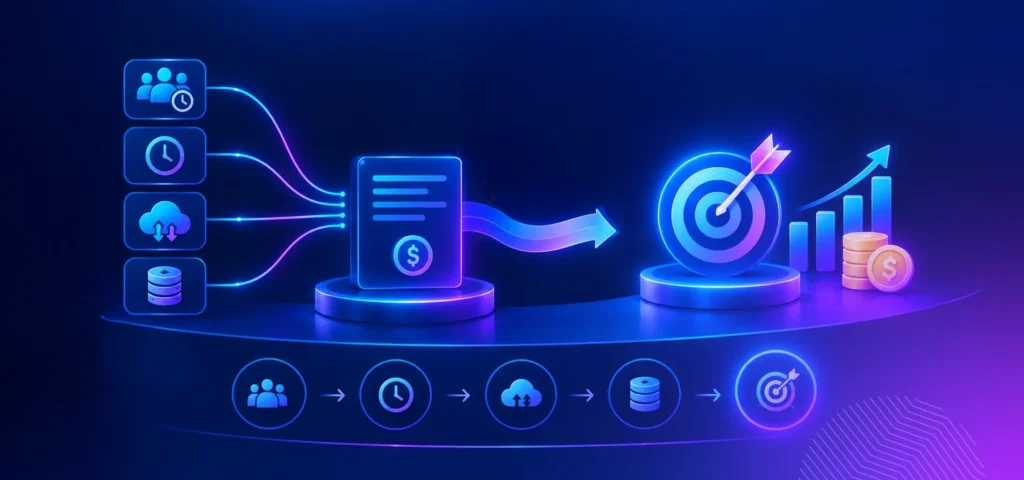
Most billing models charge based on access, time, or volume. But outcome-based billing flips that on its head: you only charge when you deliver a specific result. It’s not about how many times someone logs in or how often a task is attempted; it’s about the outcome that truly matters to your customer.
For instance, a per-ticket billing model for IT support only charges when a ticket is resolved, not based on how many agents are available. Similarly, a marketing platform might use a per-conversion pricing model that charges only when a lead converts, rather than per email sent. This shifts the focus from input to output, creating a more valuable exchange.
This isn’t just a small change. It transforms your sales approach, alters how customers view risk, and impacts your revenue flow. The core idea is straightforward: if your customer is buying a result, then price the result.
If you look up “SaaS pricing models,” you’ll find lots of information about per-seat, tiered, and usage-based billing. However, outcome-based pricing hardly gets a nod. This is a missed opportunity because demand is already growing. Finance leaders want expenses linked to ROI, buyers resist paying for tools that don’t deliver results, and advances in AI make it easier than ever to define, track, and connect outcomes with results.
Despite this, most pricing advice and billing frameworks still focus on counting units like API calls, users, or hours. Adopting outcome-based billing requires a fresh perspective.
This guide is designed for people who are seriously considering their revenue models: SaaS founders who are looking to implement performance-based pricing to reduce churn and boost deal closure rates, agency owners wanting to move away from retainers and instead tie fees to measurable results like qualified leads, RevOps and finance leaders who need to grasp how to track, invoice, and recognize revenue in outcome-based deals, and managed service providers aiming to stand out with per-ticket or per-resolution billing.
What Is Outcome-Based Billing?
Outcome-based billing is a pricing approach where you charge customers based on tangible outcomes rather than time spent, seats used, or resources consumed. In this model, customers pay when a specific milestone is achieved, such as when a support ticket is resolved, a lead converts, or a transaction completes successfully.
This method turns the traditional billing relationship on its head. Instead of asking customers to pay just for access and hoping they find value, you connect your revenue directly to the benefits they actually experience.
Here’s a quick comparison:
| Model | Customer pays for | Example |
| Per-seat / subscription | Access | $50/user/month |
| Hourly / time-based | Effort | $150/hour of consulting |
| Usage-based | Consumption | $0.01 per API call |
| Outcome-based | Results | $5 per resolved ticket |
Why Outcome-Based Pricing Matters Now
Three key factors are driving the shift from viewing outcome-based billing as just an intriguing concept to seeing it as a must-have for competitiveness.
1. Buyers want proof of ROI before renewing.
CFOs are cutting ties with tools and vendors that can’t show a measurable impact. According to a 2024 Gartner survey, a whopping 72% of SaaS buyers now seek verifiable business outcomes during renewal discussions. If your pricing is already linked to results, that conversation practically takes care of itself.
2. AI and automation make outcomes easier to track.
Tracking outcomes used to require manual effort. Now, event-driven architectures, APIs, and automation make it much easier to define, measure, and connect outcomes to billing.
3. Your competitors haven’t caught on yet.
Most SaaS and service companies still lean towards traditional per-seat or flat-rate pricing models. Because of this, businesses that adopt pay-per-result pricing have a real opportunity. Those who take the leap first can establish themselves as low-risk, high-accountability options in their market.
How to Choose the Right Outcome to Bill For
The first step is identifying an outcome that is both measurable and valuable. Not everything you can track should become a billable event.
The ideal outcome has three characteristics:
- The customer recognizes it as valuable.
- You can measure it objectively.
- You can verify when it has occurred.
For example, “hours of support provided” is an activity, while “support ticket resolved” is an outcome. Similarly, “emails sent” is an activity, while “qualified lead generated” is an outcome.
1. Start With the Customer’s Definition of Value
Ask what your customer is actually trying to achieve with your product or service. Let the answer guide the billing metric.
If customers buy your service to resolve issues, a resolved ticket may be the right outcome. If they use your platform to generate business, a qualified lead or completed conversion may be more meaningful.
2. Make the Outcome Verifiable
An outcome-based billing model depends on objective measurement. Both the provider and customer should agree on whether an outcome occurred.
This is particularly important when billing disputes could arise. Clear definitions, measurable events, and reliable tracking reduce ambiguity and make the billing relationship easier to manage.
Common Outcome-Based Billing Models
Outcome-based billing can take several forms depending on the type of result being delivered. The right model depends on what the customer considers valuable and what the provider can reliably measure.
1. Per-Resolution Billing
The customer pays each time a specific issue is successfully resolved.
This model works well for managed services, IT support, customer service, and other businesses where resolution is the primary value delivered.
2. Per-Conversion Billing
The provider charges when a defined conversion takes place, such as a qualified lead becoming a customer.
This approach is particularly relevant for performance marketing, lead-generation platforms, and sales-focused services.
3. Per-Transaction Billing
The provider charges when a transaction completes successfully.
This can apply to payment platforms, marketplaces, financial services, and other transaction-driven businesses.
4. Performance-Based Billing
The provider’s fees are tied to a broader business outcome, such as revenue generated, cost savings achieved, or another agreed performance metric.
This model creates a stronger alignment between the provider’s revenue and the customer’s results, but it also requires clear attribution rules and reliable measurement.
Outcome-Based vs. Usage-Based vs. Value-Based Billing
It’s easy to mix up these three billing models, but each has a distinct focus on what customers pay for. Here’s a quick rundown:
| Outcome-Based | Usage-Based | Value-Based | |
| What the customer pays for | A specific result | Resource consumption | The perceived value of the product |
| Billing trigger | Delivery of the outcome (e.g., resolving a ticket or achieving a conversion) | Units used (e.g., API calls, GB of storage) | A negotiated price based on what the buyer is willing to pay |
| Revenue predictability | Variable | Variable | More stable |
| Risk allocation | Provider bears more risk | Shared | Customer bears more risk |
| Example | $8 for each qualified lead | $0.01 for each API request | $50K/year based on the tool saving $500K |
Usage-based billing, also known as metered billing, charges customers based on how much they use a service. For instance, a cloud provider might bill you for every hour of computing power you consume, regardless of whether you find value in it. The relationship between what you pay and the resulting benefit is indirect.
On the other hand, value-based billing sets prices based on how much the market, or a specific buyer group, is willing to pay relative to the value they perceive. This approach is more about strategy than just tracking usage. For example, a CRM might charge enterprise clients three times as much as startups for similar features, leveraging the value they provide.
Outcome-based billing stands out because it directly ties fees to results. If there’s no result, there’s no charge. Think of it like a pay-per-conversion model for an advertising platform: the advertiser pays $20 only for each signup, not for every impression or click. This means the provider gets paid only when the desired outcome is achieved.
How to Implement Outcome-Based Billing: A Step-by-Step Process
Switching to outcome-based billing is more than changing your pricing structure; it’s a significant shift in how your business operates. Here’s a straightforward guide to help you make the switch smoothly without impacting your revenue flow.
1. Define the Outcome You’re Selling
Start by identifying an outcome that is specific, measurable, and clearly connects to the value your customers care about. For instance, “resolved support tickets” is a solid choice, while “better customer experience” is too vague.
Some great outcomes to consider:
- Tickets resolved
- Qualified leads delivered
- Successful conversions or transactions
- Hours of uptime maintained
If you can’t measure it easily, don’t base your billing on it.
2. Agree on Measurement Rules Up Front
This step is crucial because pay-per-result agreements often stumble here. Before finalizing the deal, ensure you and your customer are on the same page regarding:
- What counts: For example, does a resolved ticket mean the agent closed it, or that the end user has confirmed it’s resolved?
- Who measures: Will it be your system, their system, or a mutual source of truth?
- Dispute window: How long does the customer have to contest an outcome that’s been counted?
For instance, if a performance marketing agency charges per conversion, both parties should agree on the attribution window (like a 7-day click or 30-day attribution) and the tracking platform (using the agency’s analytics rather than the client’s separate tool) before getting started.
3. Set Pricing Per Outcome
When setting prices for each outcome, factor in your costs and desired profit margin, and benchmark against what the customer would typically spend under different billing models. For example, if a client pays $10,000 per month for support and you handle about 500 tickets, pricing each ticket around $18–22 can offer cost predictability for them and potential growth for you if ticket volume increases.
4. Build Invoicing Around Event Data
Manual counting isn’t sustainable. Connect your billing system to the platform where the outcomes are tracked, whether it’s your CRM, ticketing system, or analytics tool—so invoices can be automatically generated based on real data. This is where billing automation becomes essential.
5. Start with a Hybrid Model
To ease the transition and minimize risk for both parties, consider starting with a hybrid model. This could involve a smaller base fee coupled with a charge for each outcome. This setup helps ensure a steady revenue stream while letting you show that the new model works. Once you’ve built trust and gathered sufficient data, you can gradually increase the emphasis on the outcome-based pricing.
Throughout this process, remember: document everything before the engagement begins, rather than waiting until the first invoice dispute arises.
Challenges of Outcome-Based Pricing and How to Mitigate Them
Outcome-based billing is a great way to align incentives, but it comes with operational challenges. Let’s take a look at the common hurdles you might face and some practical ways to tackle each issue.
1. Attribution
When you bill based on conversions or qualified leads, clients may wonder: “Did your product really make that happen?” If they’re using multiple marketing tools, it can quickly get complicated to prove your contribution when you’re charging per conversion.
Mitigation: To avoid confusion, set clear attribution rules in your contract before you start working. Establish a method for tracking results, such as first-touch, last-touch, or a shared model, and agree on a single source of truth for measurement. The goal is to eliminate ambiguity from the start, so you don’t end up in a dispute when it’s time to invoice.
2. Revenue Volatility
With outcome-based pricing, your income can really fluctuate based on your customer’s performance. If, for instance, a client’s ticket volume drops by 40% in a quarter, your billing based on ticket resolutions will also take a hit, even if your platform is running smoothly.
Mitigation: Consider using a hybrid pricing structure. Charge a base fee that covers your basic costs, then add outcome-based pricing on top. For example, an IT support provider could charge a $2,000 monthly platform fee plus $8 for each resolved ticket. This way, you protect yourself from significant income drops while still incentivizing performance.
3. Scope Creep
Clients on outcome-based agreements often ask for more, whether it’s additional support, more customization, or enhanced reporting, because they feel the financial risk is lower for them.
Mitigation: Clearly outline what’s included in the outcome price from the start. Document the boundaries in your service agreement.
4. Customer Disagreements
Disputes can arise when a customer’s internal data doesn’t match yours. For example, if your SaaS platform counts 200 qualified leads but the client’s CRM shows only 170, things could get contentious.
Mitigation: Set up a real-time dashboard both parties can access to track data. Regularly reconcile the numbers, preferably monthly instead of quarterly, to stay on the same page. Also include a dispute-resolution window in your terms (e.g., 10 business days after an invoice is issued) to address discrepancies promptly.
| Challenge | Root Cause | Best Mitigation |
| Attribution | Unclear cause-and-effect link | Pre-agreed tracking rules |
| Revenue volatility | Income tied to client performance | Base fee + outcome layer |
| Scope creep | Client perceives minimal risk | Defined service boundaries |
| Data disagreements | Mismatched measurements | Shared dashboard, regular reconciliation |
While these challenges can seem daunting, they are not insurmountable. By implementing clear contracts, sharing data effectively, and using automation to track outcomes accurately from the start, you can navigate these challenges successfully.
Benefits of Outcome-Based Billing
Outcome-based billing can create meaningful benefits for both providers and customers because it connects payment directly to measurable results.
1. For Buyers
Customers benefit from lower perceived risk because they pay only when the agreed outcome is delivered. This can make it easier to justify the investment internally and connect spending to measurable business results.
2. For Providers
Providers can differentiate themselves from competitors that rely on traditional pricing models. When providers consistently deliver measurable outcomes, revenue can scale with the value created.
Is Outcome-Based Billing Right for Your Business?
Not every business is suited for charging based on results. Outcome-based pricing works best when you can clearly define, measure, and connect the outcome to what you’re offering. If any of these elements are missing, you’re likely to spend more time disagreeing about invoices than actually boosting your revenue.
Try this quick checklist to see if outcome-based billing could work for you:
| Question | If Yes | If No |
| Can you explain the outcome in one sentence? | Great fit | Stop here: ambiguity can sink deals |
| Can you measure it without depending solely on the customer’s data? | Great fit | High risk for disputes |
| Is the outcome something you can repeat and control? | Great fit | Revenue may be too unpredictable |
| Can your billing system track and invoice for each outcome? | Great fit | You’ll need to automate first |
| Does your customer already think about this outcome? | Easy sell | Be prepared for a longer education curve |
A Simple Decision Framework
When considering outcome-based billing, ask yourself these three questions:
- Can I count it? The outcome needs a numeric value: tickets, conversions, qualified leads, or uptime hours.
- Can I prove it? You should have independent or shared tracking methods. If the customer has all the data, your negotiating power decreases.
- Can I handle fluctuations? Think about your worst month. If a 40% drop in outcomes could hurt your cash flow, consider adding a base fee or minimum commitment to your pricing setup.
How to Automate Outcome-Based Invoicing
With outcome-based billing, manual invoicing can slow you down. Since every invoice is tied to different result counts, like tickets resolved, conversions made, or leads qualified, relying on spreadsheets and monthly reconciliations can quickly turn into a headache.
But there’s good news: automation can tackle this challenge by improving accuracy, speeding up the process, and building trust. With automation, your customers will see the same data you do, invoices can be sent out without any manual counting, and disputes are likely to decrease significantly.
Here’s a look at what automating your outcome-based invoicing might look like:
- Connect your outcome data source. Make sure your CRM, ticketing system, ad platform, or product database is your go-to reference point. For example, an IT managed service provider can link their helpdesk so every resolved ticket automatically integrates into their billing system.
- Define your billing rules. Establish the price per outcome, any thresholds or caps on the number of outcomes, and your billing cycle. A pay-per-conversion agency, for instance, may charge $50 for each qualified lead up to 200 leads, then drop the price to $40 for any additional leads.
- Automatically generate metered invoices. At the end of your billing cycle, your platform will pull outcome counts, apply your pricing rules, and create an itemized invoice, all without manual data extraction.
- Provide real-time dashboards for customers. Transparency is key! Share live or near-live views of the outcome data with your customers, so there won’t be any surprises when the invoice comes.
- Set up automated rules for edge cases. Think ahead about how to handle disputed outcomes, chargebacks, or partial results. Having those rules programmed into your system will save you time and hassle later on.
Key Features to Look for in a Outcome-Based Billing Automation Platform
| Capability | Why It Matters |
| API-based event ingestion | Easily gathers outcome data from any source |
| Flexible pricing logic | Supports per-result, tiered, and hybrid pricing models |
| Customer-facing usage portal | Helps build trust and minimizes disputes |
| Revenue recognition support | Ensures compliance as your result counts fluctuate |
| Automated proration and adjustments | Smoothly manages any mid-cycle changes |
Without automation, managing outcome-based pricing can lead to more operational challenges than it’s worth. But when you embrace it, you can develop a scalable revenue model that truly delivers on the promise of getting paid for results.
How Evergent Automates Outcome-Based Billing and Invoicing
Outcome-based billing depends on reliable operations. Businesses need to capture outcome events, apply pricing rules, invoice from real data, and maintain a shared source of truth. That’s where Evergent helps.
Evergent ingests outcome data from ticketing systems, CRMs, ad platforms, and product databases, then applies per-result, tiered, or hybrid pricing. Teams can combine a base fee with outcome charges and adjust pricing as the model evolves without rebuilding their billing stack.
Automated, itemized invoices make every charge traceable to a result, while real-time dashboards reduce attribution disputes and data mismatches. Configurable rules also handle disputed outcomes, partial results, and other billing exceptions.
Evergent supports revenue recognition, proration, and mid-cycle adjustments as outcome volumes change. For SaaS companies, MSPs, agencies, media, and telecom businesses, it provides the infrastructure to scale outcome-based, subscription, and usage-based pricing.
FAQs on Outcome-Based Billing
What is outcome-based billing?
Outcome-based billing is a pricing model where customers pay only when you deliver a specific result, such as a resolved support ticket, a converted lead, or a completed transaction, rather than paying for access, time, or units consumed. It ties revenue directly to the value customers experience, so if the expected result does not happen, the customer pays nothing. This shifts more risk to the provider but offers a stronger sales proposition for anyone who can consistently deliver.
How is outcome-based billing different from usage-based billing?
The difference between outcome-based billing and usage-based billing is what triggers the charge. Usage-based billing charges for consumption such as API calls, storage, or compute hours, regardless of whether the activity produced value. Outcome-based billing charges only when a defined result is achieved; an API call is an action, while a converted lead is an outcome. Both need tracking systems, but outcome tracking also requires defining success and agreeing on attribution.
What is the difference between outcome-based, usage-based, and value-based billing?
The difference between outcome-based, usage-based, and value-based billing is what the customer pays for and where the risk sits. Outcome-based billing charges for a specific result delivered, with the provider bearing more risk. Usage-based billing charges for resource consumption, with risk shared. Value-based billing charges a negotiated price tied to perceived value, with the customer bearing more risk and revenue that is generally more stable.
What are the common outcome-based billing models?
The common outcome-based billing models are per ticket resolved, per conversion, per qualified lead, per successful outcome, and per unit produced or delivered. Per-ticket models suit IT helpdesks and managed service providers, per-conversion suits performance marketing and CRO tools, per-qualified-lead suits lead generation agencies, per-successful-outcome suits recruiting and insurance automation, and per-unit suits content production and data processing. The right model depends on how you measure the value your customer receives.
What are the main challenges of outcome-based billing?
The main challenges of outcome-based billing are attribution, revenue volatility, scope creep, and customer disagreements over data. Attribution is solved with pre-agreed tracking rules and a single source of truth; revenue volatility with a base fee plus an outcome layer; scope creep with clearly defined service boundaries; and data disputes with a shared real-time dashboard, regular reconciliation, and a dispute-resolution window written into the terms.
How do you implement outcome-based billing?
You implement outcome-based billing by defining a specific, measurable outcome, agreeing on measurement rules up front, setting pricing per outcome, building invoicing around event data, and starting with a hybrid model. The measurement rules matter most: agree on what counts, who measures it, and how long the dispute window is before the deal starts. Documenting everything before the engagement begins is what prevents disputes when the first invoice arrives.
When is outcome-based billing right for your business?
Outcome-based billing is right for your business when you can count the outcome, prove it with independent or shared tracking, and absorb fluctuations in your worst month. It works well for measurable, provider-controlled results like resolved tickets or tracked conversions, and gets risky when the outcome is vague, such as “successful brand outcomes,” or when your product influences a result it does not fully control, such as a sales tool billing per closed deal. If you cannot measure or attribute the outcome cleanly, a base fee or hybrid model is safer.
How do you automate outcome-based invoicing?
You automate outcome-based invoicing by connecting your outcome data source, defining billing rules, generating metered invoices automatically, providing real-time dashboards, and setting automated rules for edge cases. The platform pulls outcome counts at the end of the cycle, applies your pricing, and produces itemized invoices without manual counting. When choosing a billing platform, look for API-based event ingestion, flexible pricing logic, a customer-facing usage portal, revenue recognition support, and automated proration.