Customer support has become one of the hardest challenges in streaming. Subscribers expect the same fast, personalized service they get from their favorite apps. Behind the scenes, many OTT operators still run support across disconnected tools.
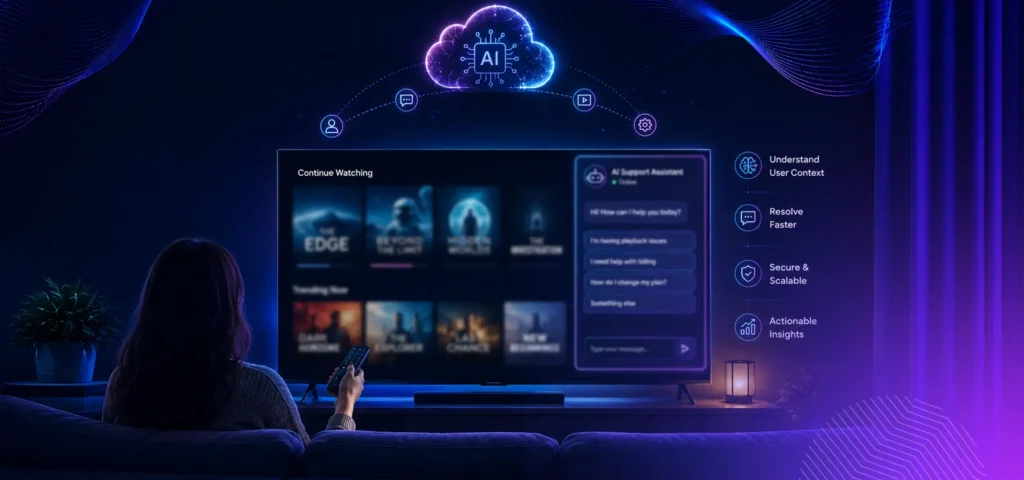
Working with Amazon Web Services (AWS), Evergent set out to solve this with ACE, an AI-driven customer support platform built on AWS. Powered by Amazon Connect, Amazon Bedrock, and Amazon Lex, ACE reduced average handling time by 40%, cut resolution time by up to 50%, and consolidated six systems into one.
Here’s how the collaboration came together.
The Problem: Support Built On A “Broken Pipeline”
For media and entertainment platforms, customer support is not a back-office function. It is where subscriber relationships are won or lost. Support teams handle high volumes of queries across chat, phone, and email. Every interaction depends on fast, accurate access to subscriber data.
The challenge is where that data lives. In most OTT environments, different vendors manage customer care, billing, analytics, payments, and content. Each has its own interface and data model. To resolve one query, an agent may need to switch between several applications and piece together the context manually.
In one deployment, support teams were working across six applications. Evergent Product Manager Vivek Sadhineni described the setup as a “broken pipeline.” Support quality depended on whether every integration was working that day.
The impact was clear:
- No real-time context. Even logged-in subscribers were often asked to provide basic account details again. As Sadhineni explains, a logged-in user expects the system to recognize them and surface the information they need.
- No understanding of intent. Rule-based support systems could not understand what customers wanted or personalize responses.
- Lost visibility. Interactions from non-logged-in users were not consistently captured, limiting follow-up and engagement opportunities.
This fragmentation was more than an efficiency problem. It created a disjointed customer experience at a critical moment for subscriber retention.
The Solution: A Unified, Context-Aware Platform Built On AWS
To solve the fragmentation, Evergent partnered with AWS to centralize subscriber data and rebuild support around a single, context-aware workflow. The result was ACE, or Advanced Customer Experience, an AI-powered platform built on AWS that connects customer interactions directly to subscriber lifecycle data.
As Ria Kapila, Evergent’s Chief AI and Product Officer, explains, the goal was to build a system that understands the customer, their subscription, and their history, then responds naturally and conversationally. Delivering that required Evergent’s subscriber lifecycle expertise combined with AWS’s AI and contact-center services.
Three moves made this possible, each built on an AWS service.
1. Consolidate interactions with Amazon Connect
Evergent replaced an existing CRM-based communication system and brought customer interactions into its platform using Amazon Connect. This reduced agents’ reliance on multiple tools. They could view subscriber, billing, and order information in one workflow instead of switching between screens.
2. Anchor everything to a single source of truth
ACE integrates directly with Evergent’s subscriber lifecycle management system, which holds the authoritative record for subscriber, payment, and order data.
By tying interactions to this source of truth, ACE can recognize logged-in users automatically and surface relevant information without requiring the agent or customer to provide it again.
“We built a platform that understands who the customer is, what they’re subscribed to, and what they’ve already done, so the agent doesn’t have to ask,” says Sadhineni.
3. Add intelligence with Amazon Bedrock and Amazon Lex
To move beyond static, rule-based flows, Evergent used Amazon Bedrock to generate context-aware responses based on real-time subscriber data. Amazon Lex interprets customer intent and guides conversations dynamically.
Together, these AWS services turn a rigid decision tree into a responsive, conversational experience. This capability sits at the heart of ACE’s results.
The Outcome: 40% Faster Handling, 50% Faster Resolution, Powered By AWS
Consolidating the systems and applying AWS’s AI capabilities produced measurable gains across the support workflow. As Kapila explains, AI capabilities on Amazon Bedrock reduced handling time by approximately 40% and time to resolution by up to 50% because agents could access the right information faster.
- Average handling time fell by roughly 40%. Agents reach the right information faster, so each interaction moves more quickly.
- Time to resolution dropped by up to 50%. Context is surfaced automatically, so agents spend less time searching and more time resolving issues.
- Six systems consolidated into one platform. A single interface, built on AWS, replaced the need to work across multiple applications.
The screen-switching tax shows the difference clearly. Before ACE, answering one query across multiple systems could take up to 40 seconds. Across thousands of interactions, that added significant time. The unified workflow has reduced it dramatically.
ACE also closed a visibility gap for operators. By capturing data across support channels, including interactions from non-logged-in users, the platform provides a fuller view of customer behavior. Operators can now identify follow-up and engagement opportunities that were previously difficult to capture.
Why Context Is The Real Unlock
It’s tempting to read this as a story about AI. It’s really a story about context and pairing the right subscriber foundation with the right AI services.
Chatbots and generative models are only as good as the data they can access. Adding a language model to six disconnected systems may make responses faster, but not necessarily better. ACE works because Evergent solved the data problem first. It unified interactions and connected them to an authoritative subscriber record. AWS services such as Amazon Bedrock and Amazon Lex could then work with complete, real-time information.
For OTT and media operators, that order matters. Personalized, conversational support is not a feature you simply switch on. It depends on subscriber data being unified, current, and accessible when an interaction happens. It also requires AI services that can act on that information.
Evergent’s lifecycle management platform provides the foundation. AWS provides the intelligence layer on top.
Building on the collaboration, Evergent is extending ACE with an intelligent agent workspace that captures conversation context, summarizes interactions, and recommends next-best actions. This is the next step toward faster, more consistent support. With support already unified and context-aware, ACE can take on more of the work that agents do today.