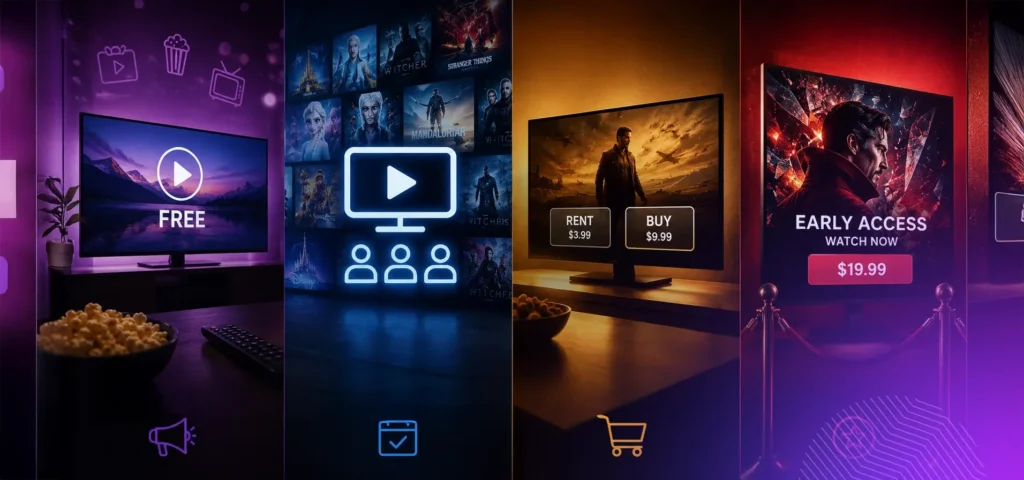
AVOD, SVOD, TVOD, and PVOD are four common video-on-demand monetization models.
AVOD means viewers watch content for free and see advertisements. SVOD, or subscription video on demand, charges a recurring fee for access to a content library. TVOD lets viewers rent or buy individual titles. PVOD is similar to TVOD, but charges a premium for early access to new releases.
The difference between AVOD, SVOD, TVOD, and PVOD comes down to how viewers pay, when they pay, and how the streaming service generates revenue.
Many streaming platforms now combine two or more models. A service might offer a free ad-supported tier, a paid subscription, and premium rentals within the same platform. This hybrid approach gives operators more ways to reach viewers and monetize different segments.
If you are evaluating a streaming business, the right question is not simply which model is best. It is which monetization model best fits your audience, content, pricing strategy, and growth goals.
AVOD vs SVOD vs TVOD vs PVOD: Quick Comparison
| Model | What the viewer pays | How the service makes money | Best suited for | Typical examples |
| AVOD | Nothing | Advertising | Large audiences, evergreen content, and broad-reach libraries | Tubi, Pluto TV, YouTube |
| SVOD | Recurring monthly or annual fee | Subscriptions | Deep libraries and services with regular content releases | Netflix, Disney+ |
| TVOD | One-time rental or purchase fee | Per-title transactions | Premium titles and occasional viewing | Apple TV rentals |
| PVOD | Higher one-time fee | Premium per-title transactions | New releases and early-access content | Early digital movie releases |
What is AVOD?
AVOD means Ad-Supported Video on Demand. Viewers can access content without paying a subscription, while the streaming service generates revenue from advertising.
AVOD works particularly well when the goal is to maximize reach. Removing a subscription fee reduces the barrier to entry and allows a service to attract a larger audience.
The trade-off is that revenue depends on audience scale, viewing time, advertising demand, and the service’s ability to monetize impressions effectively.
What is SVOD?
SVOD means Subscription Video on Demand. Viewers pay a recurring fee, usually monthly or annually, to access a library of content.
The subscription model creates more predictable recurring revenue and gives operators a direct economic relationship with their customers. Its challenge is retention. A subscriber who does not see enough value can cancel at the next billing cycle.
For SVOD services, content quality, release frequency, pricing, engagement, and churn management all play a role in long-term revenue.
What is TVOD?
TVOD means Transactional Video on Demand. Instead of paying for access to an entire library, viewers pay for individual titles. They may either rent a title for a limited period or purchase it for ongoing access.
TVOD is useful when viewers want specific premium content without committing to a recurring subscription. It can also complement an SVOD service by providing additional revenue from titles that sit outside the subscription catalog.
What is PVOD?
PVOD means Premium Video on Demand. It is a form of transactional streaming in which viewers pay a premium to access a new release earlier than they would through a standard streaming or subscription window.
The model is designed around the value of early access. A new movie, special event, or other high-demand title can command a higher one-time price during a limited release window.
PVOD can generate higher revenue per transaction, but its success depends heavily on content demand, pricing, release timing, and the perceived value of getting the content early.
How Do AVOD, SVOD, TVOD, and PVOD Make Money?
The four models monetize viewing in different ways:
- AVOD: Revenue comes primarily from advertising.
- SVOD: Revenue comes from recurring subscription fees.
- TVOD: Revenue comes from individual rentals or purchases.
- PVOD: Revenue comes from premium-priced transactions, typically for early access.
The models also carry different economic trade-offs. AVOD prioritizes audience scale, while SVOD prioritizes recurring revenue and subscriber retention. TVOD and PVOD prioritize revenue per transaction.
That is why many operators are moving toward hybrid VOD (HVOD) strategies instead of relying on a single model.
AVOD, SVOD, TVOD, and PVOD Are Not Mutually Exclusive
A modern streaming platform does not always have to choose one monetization model.
A service can use AVOD to attract viewers with free content, SVOD to monetize customers who want ongoing access, and TVOD or PVOD to monetize premium titles or early releases.
This creates a broader value ladder:
Free, ad-supported access → Paid subscription → Premium transaction
The right combination depends on the operator’s audience, content rights, business model, and willingness to trade reach for revenue per viewer.
Where Does FAST Fit?
FAST means Free Ad-Supported Streaming Television. FAST services give viewers free access to linear-style streaming channels funded by advertising.
FAST is closely related to AVOD because both are ad-supported and free to the viewer. The key difference is the viewing experience. AVOD typically lets viewers choose individual on-demand titles, while FAST is organized around scheduled channels and a lean-back linear experience.
Many streaming operators use both.
Understanding this distinction matters when evaluating the broader streaming monetization landscape. AVOD, SVOD, TVOD, PVOD, and FAST can all play different roles within the same streaming strategy.
Which VOD Model Is Right for Your Streaming Platform?
There is no single best VOD monetization model. The right choice depends on your content, audience, pricing strategy, and how frequently you can give viewers a reason to return.
As a simple guide:
- Choose AVOD if you want to remove the price barrier, maximize reach, and monetize a large content library through advertising.
- Choose SVOD if you have enough compelling content to keep subscribers engaged and paying month after month.
- Choose TVOD if viewers are likely to pay for individual movies, programs, or other premium titles.
- Choose PVOD if you have high-demand new releases or premium content that can command a higher price for early access.
For many operators, the answer is not one model. It is a combination.
How Hybrid Monetization (HVOD) Combines the Models
Hybrid VOD (HVOD) combines multiple monetization models within the same streaming service.
A platform might offer free, ad-supported content to attract new viewers, a paid subscription for customers who want broader or ad-free access, and TVOD or PVOD for premium titles. This creates multiple paths from viewing to revenue.
A typical value ladder might look like:
Free AVOD or FAST → Ad-supported subscription → Premium SVOD → TVOD/PVOD
The advantage is flexibility. Viewers can enter at a price point that suits them, while the operator can monetize different levels of engagement and willingness to pay.
The challenge is operational complexity.
Each model introduces different pricing, billing, entitlement, promotion, and customer lifecycle requirements. A subscriber upgrading from an ad-supported plan to a premium tier is managed differently from a viewer renting a single movie. A PVOD purchase may also have different access rules from an SVOD entitlement.
These experiences still need to work together across devices, markets, payment methods, and customer accounts.
That is where the technology behind the streaming service becomes important.
How Evergent Helps Operators Manage Multiple VOD Models
Evergent helps streaming operators manage different monetization models through a unified subscription and monetization platform. Instead of managing AVOD, SVOD, TVOD, PVOD, and bundled offerings as separate operational environments, operators can manage them as connected parts of the same customer and revenue lifecycle.
This gives operators greater control over the commercial building blocks behind a streaming service, including:
- Subscription management: Create and manage subscription plans, tiers, renewals, upgrades, downgrades, and cancellations.
- Multiple monetization models: Support subscription, transactional, ad-supported, and hybrid offerings within the same broader service architecture.
- Entitlement management: Control what each subscriber or viewer can access based on their plan, purchase, promotion, or other eligibility rules.
- Pricing and packaging: Create different plans, bundles, offers, and promotional strategies for different audiences and markets.
- Payment management: Support the billing and payment processes required across recurring subscriptions and one-time transactions.
- Customer lifecycle management: Manage the journey from acquisition and activation through engagement, retention, cancellation, and winback.
- Cross-model flexibility: Give operators the ability to move customers between tiers or introduce new monetization options without creating an entirely separate operational stack.
This becomes especially important as a streaming business evolves.
An operator might begin with SVOD, introduce an ad-supported tier to reach more price-sensitive viewers, add TVOD for premium content, and later introduce bundles or new regional offerings. Each addition creates another set of commercial rules to manage.
A unified platform helps keep those rules connected.
It also gives operators more freedom to experiment. New pricing tiers, promotions, bundles, or transactional offers can be introduced without requiring separate systems for each monetization model.
Frequently Asked Questions
1. What do AVOD, SVOD, TVOD, and PVOD stand for?
AVOD stands for Advertising Video on Demand, SVOD stands for Subscription Video on Demand, TVOD stands for Transactional Video on Demand, and PVOD stands for Premium Video on Demand. These are four common video-on-demand monetization models.
2. Is Netflix AVOD or SVOD?
Netflix is primarily an SVOD service because customers pay a recurring subscription to access its content library. Netflix also offers an ad-supported subscription tier, making its overall business model a hybrid of subscription and advertising-based monetization.
3. What is the difference between AVOD and SVOD?
The main difference is how the service is monetized. AVOD provides content at no direct cost to the viewer and generates revenue primarily through advertising. SVOD charges a recurring subscription fee for access to content. Many streaming services now combine both models through different pricing tiers.
4. What is the difference between TVOD and PVOD?
TVOD charges viewers a one-time fee to rent or purchase an individual title. PVOD also uses a one-time transaction, but typically charges a premium for early access to a new release. In simple terms, PVOD is a premium transactional model built around an earlier release window.
5. Is YouTube AVOD?
YouTube’s free service is primarily ad-supported, which makes it an example of an AVOD-style business model. YouTube also offers YouTube Premium, a paid subscription that removes advertising and adds other benefits. This means the broader YouTube ecosystem combines advertising and subscription monetization.
6. What is the difference between AVOD and FAST?
Both AVOD and FAST are free to viewers and primarily funded by advertising, but the viewing experience is different.
AVOD allows viewers to select individual on-demand programs or titles. FAST, which stands for Free Ad-Supported Streaming Television, delivers scheduled, linear-style streaming channels that viewers watch much like traditional television.
In simple terms: AVOD is on demand, while FAST is channel-based and scheduled.
7. Which VOD model makes the most money?
There is no single VOD model that is most profitable for every streaming business. SVOD can provide predictable recurring revenue, AVOD can maximize audience reach and advertising revenue, and TVOD and PVOD can generate higher revenue from individual premium transactions.
Many operators therefore combine multiple models to balance audience growth, recurring revenue, and revenue per viewer.
8. What is hybrid VOD or HVOD?
Hybrid VOD (HVOD) means combining multiple monetization models within the same streaming service. For example, a platform might offer free ad-supported content, a paid subscription tier, and TVOD or PVOD for premium titles.
Hybrid monetization allows operators to serve viewers with different preferences and willingness to pay while creating multiple revenue streams from the same platform.