Subscriber lifecycle management involves a comprehensive series of processes that cover everything from subscriber acquisition, onboarding, billing, engagement, retention, payment recovery, and win-back. In an OTT platform, telcos, CSPs, and pay-TV providers’ context, the connected lifecycle management approach allows different organizational units within the company to observe and analyze the entire lifecycle of the customer, and take action at any stage.
Therefore, subscriber lifecycle management software is crucial for providers since it enables them to operate on a larger scale and remain relevant in the extremely competitive environment of the hyper-cash customer-centric OTT industry. By analyzing the characteristics of the subscriber lifecycle, the processes, and key performance indicators (KPIs) associated with each stage, the operators are able to deliver a superior experience to their customers while maximizing the lifetime value of their subscribers.
In this guide, we review what subscriber lifecycle management entails, discuss its importance in 2026, and list the six stages of the subscriber lifecycle. We also highlight the core subscriber lifecycle KPIs and provide best practices on subscriber acquisition, engagement, retention, and monetization.
What Is Subscriber Lifecycle Management?
Subscriber lifecycle management (SLM) is the practice of orchestrating every interaction a subscriber has with your platform, from their first trial to renewal, upgrade, pause, and eventual win-back, as a connected, data-driven experience. For OTT and Telco operators, it spans entitlement management, subscription billing, subscriber churn management, payment recovery, and re-engagement across devices, markets, and monetization models including SVOD, TVOD, and AVOD.
Instead of a billing event followed by silence, SLM treats every stage of the journey as a chance to deliver value, deepen engagement, prevent churn, or recover revenue. The core question it answers: what should we do right now, with this specific subscriber, based on what we know about their behavior?
Why Subscriber Lifecycle Management Matters More in 2026
Subscriber growth is no longer just about growing the number of paying customers. In increasingly competitive mature markets, OTT platforms, telcos, CSPs, and pay-TV providers vie for subscribers who are more selective and can easily switch between services due to the abundance of choice and varying offerings.
This emphasis on subscriber growth calls for a closer look at the entire subscriber lifecycle, i.e., the end-to-end journey of a customer with the company, spanning from acquisition to churn, and all the behavioral and relational nuances in between. In particular, understanding the dynamics of post-acquisition subscriber growth will be important as operators seek to drive engagement, billing realization, retention, and win-back.
Let’s take a closer look at how companies in different sectors can leverage subscriber lifecycle management to enhance their offerings.
OTT Platforms
For OTT platforms, subscriber growth typically takes the form of monthly or annual recurring revenue, depending on the platform’s subscription model. However, as the market matures and competition rises, the ability to acquire new customers becomes harder. OTT providers must invest more in driving subscriber growth by building broader content libraries, lowering prices, and launching promotional offers. At the same time, operators must re-engage their existing subscribers to promote engagement and retention and prevent them from switching to competing OTT services. Thus, lifecycle management enables OTT operators to tie acquisition, engagement, and retention to better understand churn drivers and win-back opportunities.
Telcos
Streaming services and bundles can be a great acquisition channel for telcos, but only if the product is relevant to the target customers and the sales process is optimized. Lifecycle management can help telcos tie subscriber acquisition, engagement, billing realization, and retention to identify growth opportunities and areas of improvement.
CSPs
A crucial aspect of subscriber lifecycle management for CSPs is identifying the right segments for targeting and personalization. Operators can use SLM to track and analyze the entire customer journey across products and payment methods, entitlements, and recurring and event-based billing. Subscriber lifecycle management can also enable CSPs to drive engagement, retention, and win-back while optimizing price positioning, bundles, and offers to promote growth.
PayTV
Traditional pay-TV services are undergoing a subscriber growth revolution as cord-cutting accelerates, and consumers turn to OTT video. The importance of subscriber lifecycle management will be even more significant for pay-TV providers as they must adapt to changing consumer preferences and compete more intensely with alternative video services. In this environment, SLM will be paramount to drive engagement and retention and manage the complex customer journey spanning product upgrades and bundles, billing realization, and churn management.
The 3 Subscriber Lifecycle Management Models
Subscriber lifecycle management can be structured in different ways depending on how subscribers are acquired, billed, supported, and managed. Three common models are Direct-to-Consumer (D2C), Carrier-Billed & Bundled, and Hybrid & Wholesale.
| Model | Who owns the journey | Best suited for |
| Direct-to-Consumer (D2C) | The provider manages the subscriber journey directly, from acquisition and onboarding through billing, retention, and win-back. | Standalone OTT and sports streaming platforms |
| Carrier-Billed & Bundled | The journey is shared between the operator and content provider, with onboarding, billing, entitlements, and support coordinated across organizations. | Telcos, CSPs, and pay-TV providers offering streaming through mobile, broadband, or TV bundles |
| Hybrid & Wholesale | Subscribers are acquired and managed through multiple channels, such as direct sales, carrier bundles, wholesale partners, marketplaces, and resellers. | Large OTT platforms and operators managing multiple distribution channels and markets |
The main difference between these models is who owns the subscriber relationship and how many organizations or channels are involved. As distribution becomes more complex, SLM needs to connect subscriber data and lifecycle activities across those channels.
How Does Subscriber Lifecycle Management Work?
Subscriber lifecycle management works by connecting subscriber data, analytics, workflows, and operational systems across the customer journey. Instead of managing billing, payments, engagement, support, and retention as separate functions, SLM helps providers use information from one stage to inform actions at another.
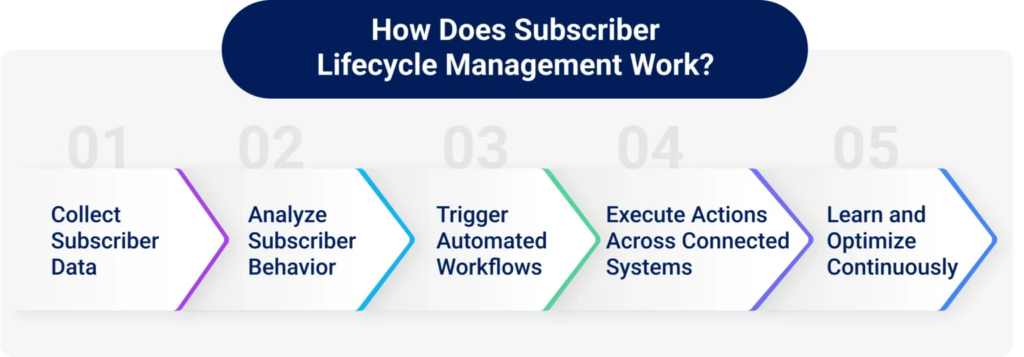
It typically works in five steps:
- Collect subscriber data: Bring together information from subscriptions, billing, payments, content consumption, support interactions, devices, and account activity.
- Analyze subscriber behavior: Identify patterns such as high engagement, declining activity, repeated payment failures, frequent support interactions, or early signs of churn.
- Trigger relevant actions: Use predefined rules, analytics, or automation to initiate actions such as payment retries, reminders, plan changes, content recommendations, support alerts, or retention campaigns.
- Execute across connected systems: Keep billing, payment gateways, entitlement platforms, CRM, customer support, and marketing systems aligned when subscribers renew, upgrade, downgrade, cancel, or recover a failed payment.
- Measure and optimize: Use the results of subscriber interactions to improve future journeys, offers, payment strategies, and retention efforts, with the goal of improving customer lifetime value (CLV).
The process is continuous: data informs decisions, decisions trigger actions, and the results create new data for the next interaction.
The 6 Stages of Subscriber Lifecycle Management
Subscriber lifecycle management covers the journey from the first subscription through engagement, renewal, payment recovery, and potential win-back. Each stage gives providers an opportunity to improve the subscriber experience, support retention, and grow recurring revenue.
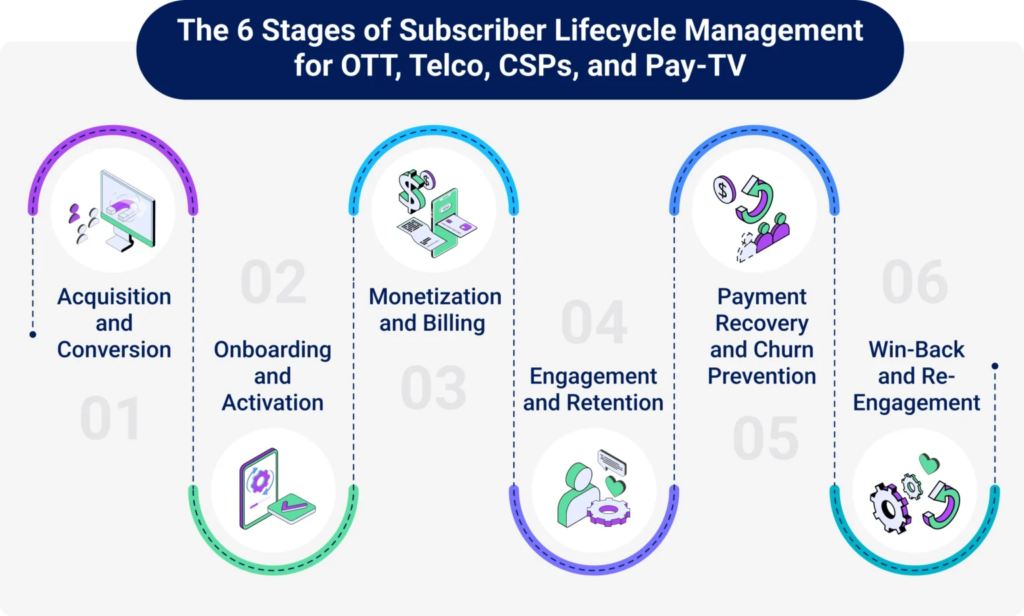
1. Acquisition & Conversion
The lifecycle begins when a prospect discovers a service and becomes a subscriber through a website, app store, carrier bundle, or other distribution channel. A smooth sign-up experience can include flexible plans, payment methods, currencies, and regional options that make it easier for prospects to complete the purchase.
2. Onboarding & Activation
Once a subscriber joins, the focus shifts to getting them started and helping them find value in the service. This can include subscription activation, device setup, profile creation, and relevant content recommendations. For bundled services, a connected activation process can make it easier for subscribers to access everything included in their plan.
3. Monetization & Billing
This stage covers how subscribers are charged and how providers manage different pricing and subscription models. It can include recurring billing, free trials, promotions, upgrades, downgrades, renewals, bundles, multiple payment methods, currencies, taxes, and regional requirements. Flexible and reliable billing helps providers manage revenue while giving subscribers more suitable payment and plan options.
4. Engagement & Retention
Providers use subscriber activity and usage patterns to understand engagement and identify opportunities to increase value. Content recommendations, personalized experiences, loyalty benefits, upgrades, and targeted retention campaigns can help keep subscribers engaged and address potential churn risk.
5. Payment Recovery & Churn Prevention
Failed payments can lead to involuntary churn when cards expire, transactions fail, or balances remain unpaid. Automated payment retries, intelligent payment retries, reminders, dunning workflows, and alternative payment methods can help providers recover payments before a failed transaction becomes a cancellation.
6. Win-Back & Re-Engagement
The subscriber lifecycle does not necessarily end when a customer cancels. Providers can analyze cancellation reasons and previous subscriber behavior to identify suitable opportunities for re-engagement. Personalized offers, relevant content, or new service options can give former subscribers a reason to return.
Together, these six stages create a connected subscriber lifecycle, where information from one stage can inform decisions in the next.
Key Benefits of Subscriber Lifecycle Management
A connected subscriber lifecycle helps providers manage customer relationships across acquisition, engagement, billing, retention, and win-back. The benefits can extend beyond subscriber experience to revenue management, operational efficiency, and better use of customer data.
- Increase customer lifetime value (CLV): Better onboarding, engagement, retention, and payment recovery can help subscribers stay active longer and increase the value generated over their relationship with the provider.
- Improve subscriber retention: By identifying changes in engagement, payment behavior, or other churn signals, providers can take action before subscribers cancel and tailor interventions to their situation.
- Improve acquisition efficiency: When subscribers remain active for longer, providers have fewer customers to replace through new acquisition. This can improve the economics of marketing and customer acquisition over time.
- Enable flexible monetization: SLM can support different plans, bundles, promotions, regional pricing, upgrades, and other subscription models as providers adapt their offerings to different markets and subscriber segments.
- Recover revenue from failed payments: Payment retries, reminders, dunning workflows, and alternative payment methods can help recover failed transactions and reduce involuntary churn.
- Gain better subscriber insights: Connecting subscription, billing, payment, engagement, and support data creates a more complete view of subscriber behavior. These insights can support segmentation, churn analysis, retention, and win-back strategies.
- Improve operational efficiency: Connecting billing, entitlements, payments, renewals, and subscriber workflows can reduce manual processes and limit the need to manage the same subscriber information across disconnected systems.
Common Challenges in Subscriber Lifecycle Management
Subscriber lifecycle management can help providers connect the customer journey, but managing that journey across multiple systems, teams, and channels comes with its own challenges. The most common include:
- No Unified View of the Subscriber
Subscriber data is often spread across billing, CRM, payment, support, and analytics systems. When these sources are not connected, it becomes harder to understand subscriber behavior, identify risk, and make informed lifecycle decisions.
- Difficulty Identifying Churn Early
Waiting until a subscriber cancels leaves limited time to respond. Providers need to monitor changes in engagement, payment behavior, and other signals to identify potential churn while there is still an opportunity to intervene.
- Complex Subscription and Billing Models
Plans, trials, bundles, add-ons, carrier billing, multiple currencies, and regional tax requirements can make subscription management increasingly complex. A scalable subscription billing platform can help providers manage these requirements across markets and subscription models.
- Personalization at Scale
Delivering relevant experiences to large subscriber bases is difficult when data is fragmented and processes rely heavily on manual work. Connected data and automation can help providers tailor offers, content, and communications to different subscriber needs.
- Keeping Teams and Systems Aligned
Marketing, product, finance, support, and operations may each work with different systems and subscriber information. Connecting these teams around consistent data can help create a more coordinated subscriber experience and reduce gaps between operational processes.
Best Practices for Subscriber Lifecycle Management
Effective subscriber lifecycle management connects data, automation, and optimization across the entire subscriber journey. The following practices can help providers manage that journey more effectively.
- Create a Single Source of Truth
Connect billing, payments, CRM, support, identity, and engagement data to create a more complete subscriber profile. This gives teams better context for personalization, segmentation, and lifecycle decisions.
- Automate Lifecycle Decisions
Use lifecycle events and subscriber behavior to trigger relevant workflows. These can include payment recovery, onboarding journeys, renewal reminders, personalized offers, and retention campaigns.
- Detect Churn Before Subscribers Leave
Monitor engagement, payment behavior, and account activity for signals that a subscriber may be at risk. Early identification gives providers more time to respond with relevant offers, plan recommendations, content, or proactive support.
- Build Flexible Monetization
Support different plans, bundles, promotions, trials, add-ons, carrier billing, and regional pricing as subscriber and market needs change. A flexible monetization approach makes it easier to test and manage different subscription models.
- Optimize the Entire Subscriber Journey
Measure performance across acquisition, activation, engagement, billing, payment recovery, retention, and customer lifetime value. SLM should be treated as an ongoing process that evolves as subscriber behavior and business priorities change.
- Re-Engage Current and Former Subscribers
Keep active subscribers engaged through relevant content, personalized experiences, and loyalty initiatives. For former subscribers, use cancellation history and previous behavior to develop more targeted win-back campaigns.
What KPIs Should You Track for Subscriber Lifecycle Management?
Track KPIs across the full subscriber lifecycle rather than relying on a single metric. The right combination of acquisition, revenue, engagement, churn, payment, and win-back metrics gives providers a clearer view of how the subscriber base is performing.
| KPI | What it measures |
| Customer Lifetime Value (CLV) | The estimated value a subscriber generates over their relationship with the provider. |
| MRR & ARPU | Monthly recurring revenue and average revenue per subscriber, helping providers monitor recurring revenue and subscriber monetization. |
| Voluntary vs. Involuntary Churn Rate | Subscribers who cancel by choice versus subscribers lost because of payment or other involuntary reasons. Tracking them separately helps identify the appropriate response. |
| Payment Recovery Rate | The percentage of failed payment attempts that are successfully recovered through retries, reminders, or other recovery workflows. |
| Trial-to-Paid Conversion Rate | The percentage of trial users who become paying subscribers, providing insight into the effectiveness of the trial and onboarding experience. |
| Cancel Deflection Save Rate | The percentage of subscribers who remain after entering the cancellation process, helping evaluate cancellation-flow interventions. |
| Win-Back Conversion Rate | The percentage of former subscribers who return after a re-engagement or win-back campaign. |
How Evergent Simplifies Subscriber Lifecycle Management
Subscriber lifecycle management is most effective when billing, payments, subscriber engagement, retention, and customer support work together. However, many OTT platforms, Telcos, CSPs, and Pay-TV providers still rely on disconnected systems, making it difficult to deliver a consistent subscriber experience.
Evergent simplifies subscriber lifecycle management by bringing these capabilities together on a single platform. Through a shared Subscriber 360 view, businesses can manage the entire subscriber journey—from acquisition and monetization to retention, customer support, and re-engagement—without relying on multiple point solutions.
Evergent Monetization Platform (EMP)
EMP provides the monetization foundation for the subscriber lifecycle. It enables businesses to launch and manage subscription services while supporting multiple business models, billing scenarios, and global payment requirements. Key capabilities include:
- Support for SVOD, TVOD, AVOD, and hybrid monetization models.
- Recurring billing, carrier billing, bundled subscriptions, and flexible pricing.
- Multiple payment methods, currencies, and regional tax compliance.
Captivate
Captivate helps businesses reduce both voluntary and involuntary churn by turning subscriber insights into automated retention actions. It enables organizations to:
- Identify subscribers at risk of churning.
- Automate cancel deflection and personalized retention campaigns.
- Recover failed payments using intelligent retries and automated dunning.
DigitalCx
DigitalCx empowers customer support teams with complete subscriber context, enabling faster issue resolution and more personalized customer interactions. It helps businesses:
- Access a unified Subscriber 360 view.
- Manage billing, subscriptions, payments, and entitlements from a single interface.
- Deliver personalized support and targeted re-engagement campaigns.
Together, EMP, Captivate, and DigitalCx provide a connected subscriber lifecycle management platform that helps OTT platforms, Telcos, CSPs, and Pay-TV providers streamline operations, reduce churn, improve subscriber experiences, and maximize recurring revenue.
Conclusion
Every subscriber interaction matters.
The way you onboard new customers, recover failed payments, personalize engagement, prevent churn, and win back former subscribers collectively determines the long-term success of your subscription business.
Subscriber lifecycle management brings these moments together into a connected strategy that helps OTT platforms, Telcos, CSPs, and Pay-TV providers deliver better subscriber experiences while maximizing recurring revenue and Customer Lifetime Value (CLV).
In a market where products can be copied and pricing can be matched, the subscriber experience becomes the true differentiator—and subscriber lifecycle management is what makes that experience possible.
See how Captivate prevents churn for OTT and Telco operators. Speak to an Evergent expert about your subscriber lifecycle strategy.
Frequently Asked Questions About Subscriber Lifecycle Management
What is Subscriber Lifecycle Management?
Subscriber Lifecycle Management is the process of managing every stage of the subscriber journey—from acquisition and onboarding to billing, engagement, retention, payment recovery, and win-back. It helps OTT platforms, Telcos, CSPs, and Pay-TV providers improve subscriber experiences, reduce churn, and maximize recurring revenue.
What are the stages of Subscriber Lifecycle Management?
The six stages of Subscriber Lifecycle Management are:
- Acquisition and Conversion
- Onboarding and Activation
- Monetization and Billing
- Engagement and Retention
- Payment Recovery and Involuntary Churn Prevention
- Win-Back and Re-Engagement
Each stage focuses on improving the subscriber experience while increasing long-term customer value.
How do OTT platforms manage the subscriber lifecycle?
OTT platforms manage the subscriber lifecycle by combining subscription billing OTT, entitlement management, subscriber engagement, payment recovery, and customer support on a unified platform. This gives businesses a complete Subscriber 360 view, helping them make better lifecycle decisions and reduce churn.
How can businesses reduce subscriber churn?
Businesses can reduce subscriber churn by improving onboarding, personalizing engagement, identifying at-risk subscribers early, using cancel deflection strategies, and recovering failed payments through intelligent retries and dunning sequences. Managing voluntary and involuntary churn separately also improves retention outcomes.
What are the best practices for Subscriber Lifecycle Management?
Some of the most effective practices include building a unified Subscriber 360 view, creating a smooth onboarding experience, automating payment recovery, personalizing subscriber engagement, monitoring churn risks, and continuously running retention and win-back campaigns.
What is the difference between Subscriber Lifecycle Management and subscription billing?
Subscription billing OTT focuses on recurring payments, invoices, renewals, and payment processing. Subscriber Lifecycle Management is broader—it covers the entire subscriber journey, including acquisition, onboarding, engagement, billing, retention, payment recovery, and re-engagement.
What KPIs should I track for Subscriber Lifecycle Management?
Some of the most important KPIs include Customer Lifetime Value (CLV), Monthly Recurring Revenue (MRR), Average Revenue Per User (ARPU), voluntary churn rate, involuntary churn rate, payment recovery rate, trial-to-paid conversion rate, cancel deflection save rate, and win-back conversion rate.
What is involuntary churn?
Involuntary churn occurs when subscribers are lost because of payment failures rather than a decision to cancel. Businesses can reduce involuntary churn using intelligent retries, smart payment routing, and automated dunning sequences to recover failed payments before subscriptions expire.
What is ARPU?
Average Revenue Per User (ARPU) measures the average revenue generated from each active subscriber over a specific period. It helps businesses understand how effectively they are monetizing their subscriber base and evaluate the success of their pricing and subscription strategies.
How is Subscriber Lifecycle Management different for Pay-TV and OTT platforms?
The core lifecycle stages remain the same for both Pay-TV and OTT platforms. However, Pay-TV providers often manage additional complexities such as bundled services, channel packages, hardware, and telecom partnerships, while OTT platforms typically focus on digital subscriptions, content engagement, and multi-device access. A unified subscriber lifecycle management strategy helps both industries manage subscribers more effectively across these different business models.